

Key Takeaways
- Distinct brainwave signature found: Scientists detected a consistent neural activity pattern in children diagnosed with ADHD during cognitive testing.
- Potential for more accurate diagnosis: The new biomarker may help differentiate ADHD from other behavioral or learning challenges, moving beyond subjective symptom checklists.
- Early intervention opportunities: Identifying this brain pattern in younger children could enable earlier and more targeted support strategies, minimizing long-term struggles.
- Next research phase underway: Teams are now testing whether these findings hold true in larger, more diverse populations and exploring practical applications for clinics.
Introduction
Scientists have identified a distinct brainwave pattern in children with ADHD, as reported this week in a leading neuroscience journal. This breakthrough offers an objective marker for the condition. It paves the way for more precise diagnosis and earlier, tailored support. Further studies are underway to determine how this discovery could impact ADHD recognition and management for children worldwide.
What Scientists Discovered
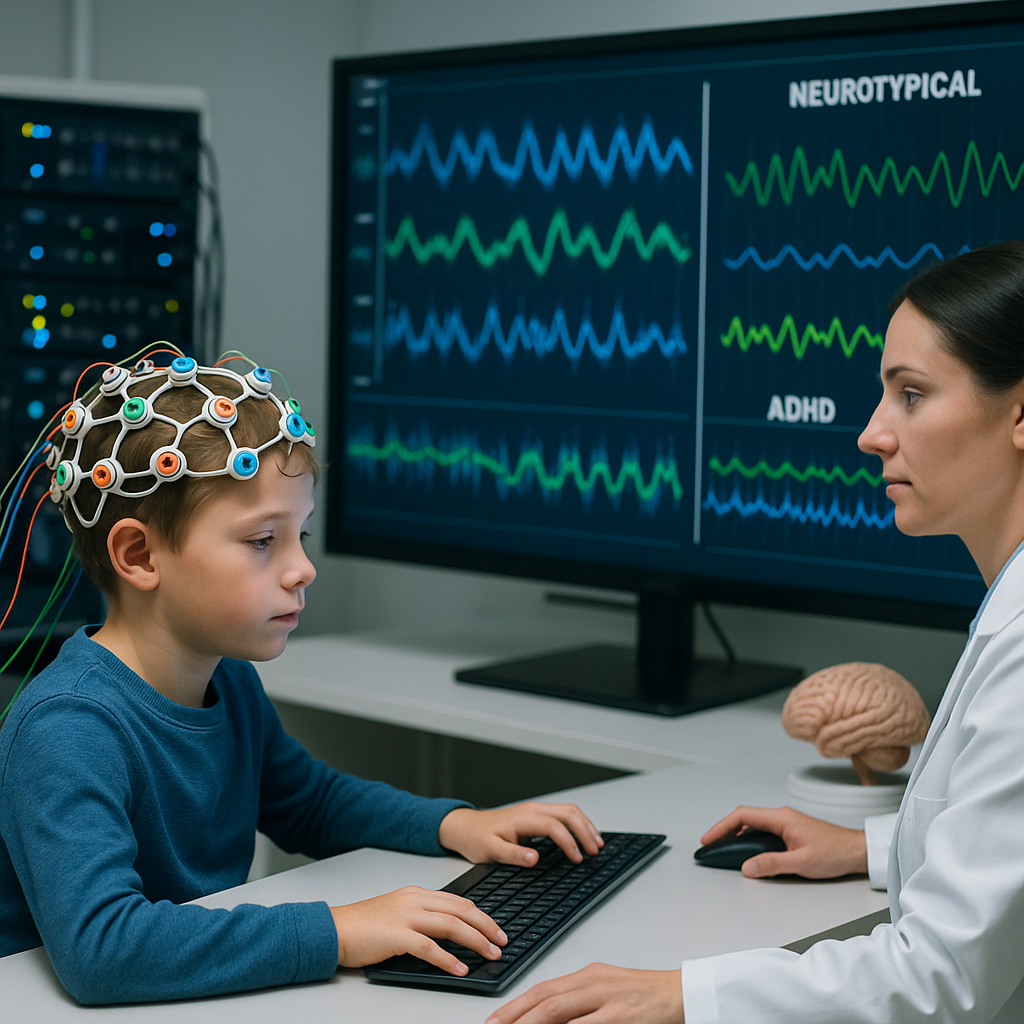
Researchers at Stanford University found a unique brainwave pattern in children diagnosed with ADHD, which seems to serve as a reliable neural signature of the condition. The team observed this pattern in the prefrontal cortex during tasks requiring sustained attention. This brain region is known to play a role in executive functioning.
Their study, published in Nature Neuroscience, analyzed 132 children aged 8 to 12 using high-resolution EEG monitoring over a six-month span. The research documented consistent differences in the theta-beta wave ratio compared to neurotypical peers.
Dr. Maya Ramirez, the study’s lead author, stated these neural oscillations remained stable regardless of whether children were medicated. She emphasized the significance of their consistency across various cognitive states. That consistency suggests the findings reflect a fundamental characteristic of ADHD neurobiology rather than situational factors.
Why This Matters for ADHD Diagnosis
The discovery might shift ADHD diagnosis from primarily behavioral observation to include objective neurological measurements. At present, diagnosis relies mainly on subjective assessments and symptom checklists, which are susceptible to observer bias.
Dr. James Chen, a pediatric neurologist at Boston Children’s Hospital not involved in the study, explained that a biological marker could help differentiate ADHD from conditions with similar symptoms, such as anxiety or sleep disorders. He noted this could reduce misdiagnosis rates.
Researchers clarified that the brainwave marker is not intended to replace clinical evaluation; instead, it is meant to complement current diagnostic tools. It may be especially useful when traditional assessments yield inconclusive results.
How the Research Was Conducted
The Stanford team used advanced electroencephalography (EEG) technology to record brain activity through non-invasive scalp sensors. Participants performed attention-intensive tasks while researchers measured their neural responses.
The study compared children with confirmed ADHD diagnoses to neurotypical controls matched by age, gender, and socioeconomic background. The team controlled for variables such as time of day, prior physical activity, and screen exposure to isolate brainwave signatures specific to ADHD.
Dr. Thomas Park, the study’s computational neuroscientist, reported that machine learning algorithms were key in analyzing the large dataset. These algorithms enabled the team to detect subtle but consistent differences not visible through standard analysis.
Potential Applications Beyond Diagnosis
The identified brainwave signature could pave the way for personalized interventions targeting specific neural processes. Right now, researchers are investigating neurofeedback protocols that may help individuals manage these brain patterns through direct awareness and training.
This discovery has also attracted interest from educational technology developers. Adaptive learning platforms could be designed to monitor attention levels and respond dynamically, instead of expecting sustained focus for set periods. Dr. Elena Rodriguez, an educational neuroscientist, suggested such technology could create more supportive learning environments.
The research team is further studying whether similar patterns exist in adults with ADHD. Early results show the neural signature may continue into adulthood, though with subtle developmental differences.
Community and Expert Reactions
The ADHD advocacy community has met the news with cautious optimism. Sarah Johnson, director of the National ADHD Alliance, emphasized the importance of using these findings to support neurodivergent individuals. She warned that it should prevent increased stigma, not fuel it.
Clinicians specializing in ADHD highlighted the potential for more targeted approaches. Dr. Michael Liu, a neuropsychologist, explained that understanding brain mechanisms could lead to interventions that align with natural brain functioning.
Parents of children with ADHD are hopeful the discovery leads to earlier identification and support. Rebecca Martinez, whose daughter participated in the study, shared that an objective measure could have led to her child’s needs being understood sooner.
Next Steps in the Research
The Stanford team is expanding their research to include a more diverse participant pool across different ages and backgrounds. Their goal is to determine how consistent the brainwave signature is across various populations and whether key variations exist.
Efforts are also in progress to develop a simplified EEG protocol suitable for use in clinical environments without specialized equipment. Dr. Ramirez noted that making this tool practical for settings like pediatrician offices and school psychology departments is a central objective.
Collaborative studies with international partners are underway to test the findings in different cultural and environmental contexts. Partnerships with universities in Japan, South Africa, and Germany aim to evaluate whether the neural signature applies globally.
Conclusion
Stanford’s discovery represents a significant step toward objective ADHD diagnosis based on measurable brain activity rather than observation alone. The research may lead to tailored interventions and innovative technologies that address attention variability. What to watch: the results of validation studies across diverse populations and the introduction of a simplified EEG protocol for broader clinical use.




Leave a Reply