

Key Takeaways
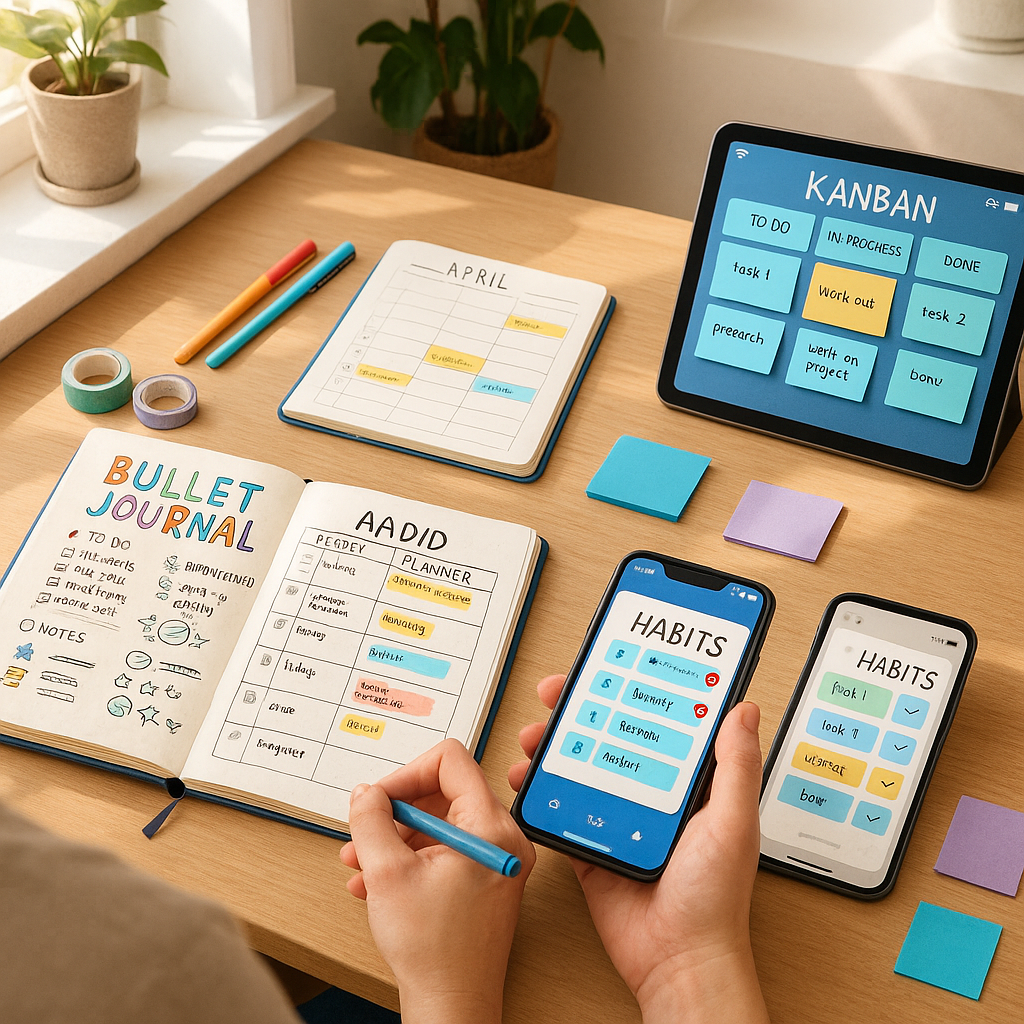
- Mix tools, maximize clarity: Combining planners, bullet journals, and habit apps enables you to play to your strengths. Use analog tools for memory and engagement, and digital options for reminders and tracking, so nothing falls through the cracks.
- Bullet journaling unlocks creativity and ownership. Custom layouts, doodles, and color-coding in bullet journals can turn task tracking from a chore into an expressive, personalized ritual that actually sticks.
- Apps automate momentum for ADHD brains. Digital habit trackers and reminder apps cut through forgetfulness by surfacing next steps and nudging action forward. This ensures progress is not dependent on willpower alone.
- Analog isn’t obsolete; handwriting boosts focus. Physically writing out plans solidifies memory and helps ADHD brains organize sprawling thoughts into visible, workable lists.
- Hybrid habit systems adapt as you do. The most effective workflows let you toggle between paper and screen, migrating tasks, syncing notes, and building flexible systems that hold up when life throws curveballs.
- Sustainability beats the “perfect system” trap. No single app, journal, or planner will work forever. ADHD-friendly tools are ones you can modify, pause, or restart without guilt, aiming for progress over perfection.
Embracing these strategies allows you to build habit systems that grow with your life and your mind. Next, let’s dive into practical tips and real-life examples to help you discover your ideal mix. With the right approach, your planner can become a supportive partner, not a pressure point.
Introduction
Choosing a habit tool when you have ADHD isn’t about picking what sounds “best” on paper. It’s about discovering what truly works for you in real life. The right blend of planners, bullet journals, and habit apps can take overwhelming chaos and transform it into a flexible, energizing, and supportive system that fits your brain’s natural rhythm.
Some are drawn to the tactile satisfaction of analog planners. Others spark creativity and motivation through bullet journals, while many benefit from the automated nudges and structured reminders that digital apps provide. Each tool brings unique strengths, and by blending analog and digital strategies, you can craft a hybrid system that evolves alongside your changing needs. This approach makes organization not only sustainable, but also deeply personal.
Let’s explore how to use planners, bullet journals, and digital apps together so your organization system becomes a true ally, empowering you rather than overwhelming you.
Understanding ADHD and Planning Challenges
How ADHD Affects Executive Function
Executive function challenges sit at the core of ADHD, impacting the ways individuals manage time, organize tasks, and develop consistent habits. The ADHD brain is wired differently, especially in areas responsible for working memory, planning, and self-regulation. These neurological differences show up in practical, everyday struggles:
- Time blindness: Difficulty perceiving the passage of time or predicting how long tasks will take
- Working memory lapses: Trouble keeping multiple steps or instructions in mind
- Task initiation barriers: Challenges in getting started, especially on less appealing tasks
- Variable attention: The ability to hyperfocus on fascinating projects, while struggling to engage with routine ones
Importantly, these experiences do not mean people with ADHD can’t be organized. Instead, the organizational systems they use need to function differently and provide additional supports. The most effective tools act as external scaffolding (serving as a kind of “external hard drive” for memory, reminders, and structure).
Recent research published in Journal of Attention Disorders highlights that visual cues and systems for external accountability dramatically improve task completion for adults with ADHD. A planning system that suits the user’s brain isn’t just helpful; it’s often essential for thriving in daily life.
Common ADHD Planning Pitfalls
Understanding the specific obstacles that individuals with ADHD face in planning can help ensure that the selected tools truly support, rather than hinder, progress.
The perfectionism trap: Many start with enthusiasm but abandon their planners or tracking systems after inevitable missteps, like missing a day or two. This all-or-nothing thinking fuels a recurring pattern of constant system-switching.
System complexity overload: Highly elaborate planning systems may be exciting at first, but quickly become overwhelming. The maintenance required for multi-step or color-coded systems often outweighs the initial dopamine reward.
Out of sight, out of mind: Tools that are not kept visible (whether planners buried in bags or apps hidden in folders) are easily forgotten. Visibility is crucial to consistent use.
The novelty factor: New systems can provide a burst of energy and focus. However, once that novelty fades, motivation drops, which can lead to abandoned systems and frustration.
Incompatibility with thinking style: Many popular tools are built around linear time and rigid sequences. For folks whose thinking is more associative or nonlinear (as is common with ADHD), these tools add friction instead of reducing it.
None of these pitfalls are personal failings. Instead, they reflect a mismatch between the user and the system. The best planning tool is one that adapts to natural tendencies, preferences, and fluctuations—not the other way around. As we examine specific options, we’ll see how different systems either support or complicate ADHD management.
Analog Planning Tools
Traditional Paper Planners: Pros and Cons
Paper planners deliver a host of tangible benefits, making them a smart choice for many with ADHD. The act of handwriting creates a robust memory link, enhancing the recall of plans and details. Neuroscience research confirms that writing by hand activates key brain regions for thinking, language, and working memory. These circuits are not as strongly engaged by digital text entry.
Benefits of traditional planners for ADHD:
- Tactile feedback delivers sensory stimulation that can improve attention during planning routines.
- A single-purpose design keeps focus on the task (unlike apps on phones or computers that can trigger distraction).
- Battery-free reliability removes barriers like dead devices or software glitches.
- The physical presence of a planner provides a stable reference point that doesn’t disappear behind digital tabs or alerts.
However, these tools also pose challenges:
- Pre-set layouts may feel inflexible when needs change.
- Forgetting to carry your planner means losing access to all your plans for the day.
- Mistakes and crossed-out tasks may trigger perfectionistic anxiety or guilt.
- Limited space can hamper capturing sprawling to-dos or ideas.
- No built-in alerts or reminders to prompt action at crucial times.
The effectiveness of a paper planner often depends on its design features. Planners with bold visuals, color-coding, and generous free space are much more ADHD-friendly than dense, linear, appointment-slotted formats. Some commercially available options built with neurodiverse users in mind offer dopamine trackers, flexible scheduling sections, and priority-marked task lists.
If considering a traditional planner, look for:
- Combined weekly and monthly overviews (to anchor time awareness)
- Open-ended space for notes, not just scheduled tasks
- Sturdy construction for repeated handling
- Minimal fixed time slots, so you can adapt layouts as your focus and energy change
Paper planners are often most effective for those who benefit from hands-on routine and consistent visual cues. Pairing daily planning with rituals, like a morning review or evening wind-down, can further increase success.
Bullet Journaling for the ADHD Brain
The bullet journal method, created by Ryder Carroll, has found passionate fans within the ADHD community. Its unique blend of open structure and clear process aligns well with the needs of neurodivergent thinkers, allowing for adaptation without loss of clarity.
Key features that support ADHD users:
- Rapid logging, with simple symbols to distinguish between tasks, events, and notes, eases cognitive load and speeds up information processing.
- Migration (reviewing and moving unfinished tasks forward) helps keep goals and responsibilities in conscious focus.
- Collections allow related notes or lists to be grouped non-linearly, fostering associative thinking.
- The index serves as a quick reference, supporting those who struggle with working memory.
Bullet journaling’s customizability is a major asset. Users can continually refine their layouts and tracking tools as their needs evolve, which is a critical feature for ADHD, where day-to-day mental states can fluctuate dramatically.
Modifications that help ADHD brains thrive:
- Mood, energy, and symptom trackers for noticing patterns and making better plans
- Medication and self-care logs to optimize routines
- Custom “dopamine chase” lists mixing easy tasks with bigger goals
- Visual aids like stickers, color codes, or icons, providing extra access points for recall
However, pitfalls exist. The blank canvas can induce perfectionism or procrastination, and elaborate spreads (as seen on social media) may overwhelm rather than inspire. Some people spend more time designing pages than actually using them.
To make bullet journaling work:
- Begin simply; focus on function before aesthetics.
- Use templates or stencils to speed up setup.
- Prep new spreads during bursts of focus, not under pressure.
- Redefine “done” as “good enough,” not Instagram-worthy.
Bullet journaling unlocks motivation for visual and kinesthetic thinkers, giving space for flexibility and creative problem-solving. Its adaptability and capacity for reinvention make it exceptionally practical for managing ADHD’s shifting landscape.
Specialized ADHD Paper Tools
Specialized paper tools designed for ADHD are gaining popularity across various fields, including education, mental health, and workplace productivity. Grounded in behavioral science, these systems are tailored to the patterns and needs of neurodivergent minds.
Examples include:
- Task cards and kanban boards: Moving physical cards through columns or stages (to-do, doing, done) engages the body as well as the mind, providing satisfying evidence of progress. This visual workflow has been adopted in project management for businesses and in therapy settings for ADHD, as it makes invisible effort visible.
- Brain dump notepads: Ideal for capturing floods of ideas quickly, these notepads let users unload scattered thoughts without immediate organization. Educators and coaches frequently recommend them to students and professionals alike to beat overwhelm.
- Time blocking and visualization pads: Rather than standard hour slots, these use color, shapes, or blocks to represent periods or moods. They help with time blindness, especially in busy jobs like healthcare or creative industries where tasks shift rapidly.
ADHD-specific planners (such as the Attention Deficit Agenda, the Taking Control ADHD Planner, or the Planner Pad; now used by lawyers, teachers, and healthcare practitioners) often add features like:
- Reward systems to boost motivation
- Distraction logs to increase mindful self-observation
- Integrated body tracking (for sleep, nutrition, exercise)
- Layouts emphasizing simplicity and color
- Prompts and guided questions to reduce overwhelm and overthinking
These specialized tools generally require less customization to be useful and often include learning tips or accountability prompts to build executive function skills over time. Potential downsides may include higher cost, limited availability, or concerns about stigma, particularly in professional settings. Yet, their effectiveness at turning obstacles into opportunities has made them valuable in both individual and workplace contexts.
Conclusion
Planning, organizing, and forming habits with ADHD isn’t about forcing yourself to match a standard mold. Instead, it’s about discovering tools and systems that adapt to how your brain naturally works. Whether you gravitate toward the tactile satisfaction of paper planners, the creative energy of bullet journaling, or specialized neuroscience-powered tools designed for ADHD, success comes from honoring your unique wiring.
In both personal and professional arenas (from healthcare and education to creative businesses), building the right infrastructure means turning potential pitfalls like time blindness or perfectionism into avenues for self-understanding and growth. Sustainability matters more than finding a “perfect” system; flexibility, adaptability, and the possibility to restart without guilt are the hallmarks of support that can help neurodivergent minds thrive.
Looking forward, the most empowered ADHD professionals and creatives will be those who continually experiment with hybrid systems, evolve their tools, and unapologetically center their needs and curiosities. Whether you are managing client projects, lesson plans, or self-care routines, your most effective planner will be the one that acts as a loyal partner. It should amplify your strengths, cushion your struggles, and enable you to design a life and career that reflect your brilliance. The future of productivity lies in systems as dynamic as the minds they serve. Now is the time to build, adapt, and succeed on your own terms.



Leave a Reply