

Key Takeaways
- A new AI app for customized ADHD task management leads today’s ADHD news and research, highlighting practical ways technology and self-care can reduce overwhelm.
- For 7 December 2025, the press review explores recent findings on screen usage, exercise, and genetic factors in ADHD, offering context for neurodivergent professionals seeking effective life systems.
- Top story: A newly launched AI app tailors task management for ADHD users and aims to make daily organization less stressful and more effective.
- Higher screen time is linked to increased ADHD symptoms in children, according to a new study.
- Structured exercise programs show significant improvements in attention and wellbeing for adults with ADHD.
- Researchers have identified rare genetic mutations that may strongly influence ADHD risk.
Introduction
A newly launched AI app that customizes task management for ADHD users leads today’s ADHD news and research for 7 December 2025, offering new ways to reduce overwhelm and improve daily organization. Alongside this innovation, recent findings highlight the benefits of structured exercise for adults with ADHD, reflecting advances in evidence-based support for neurodivergent professionals.
Top Story. AI App Delivers Customized Task Management for ADHD
Features designed for neurodivergent users
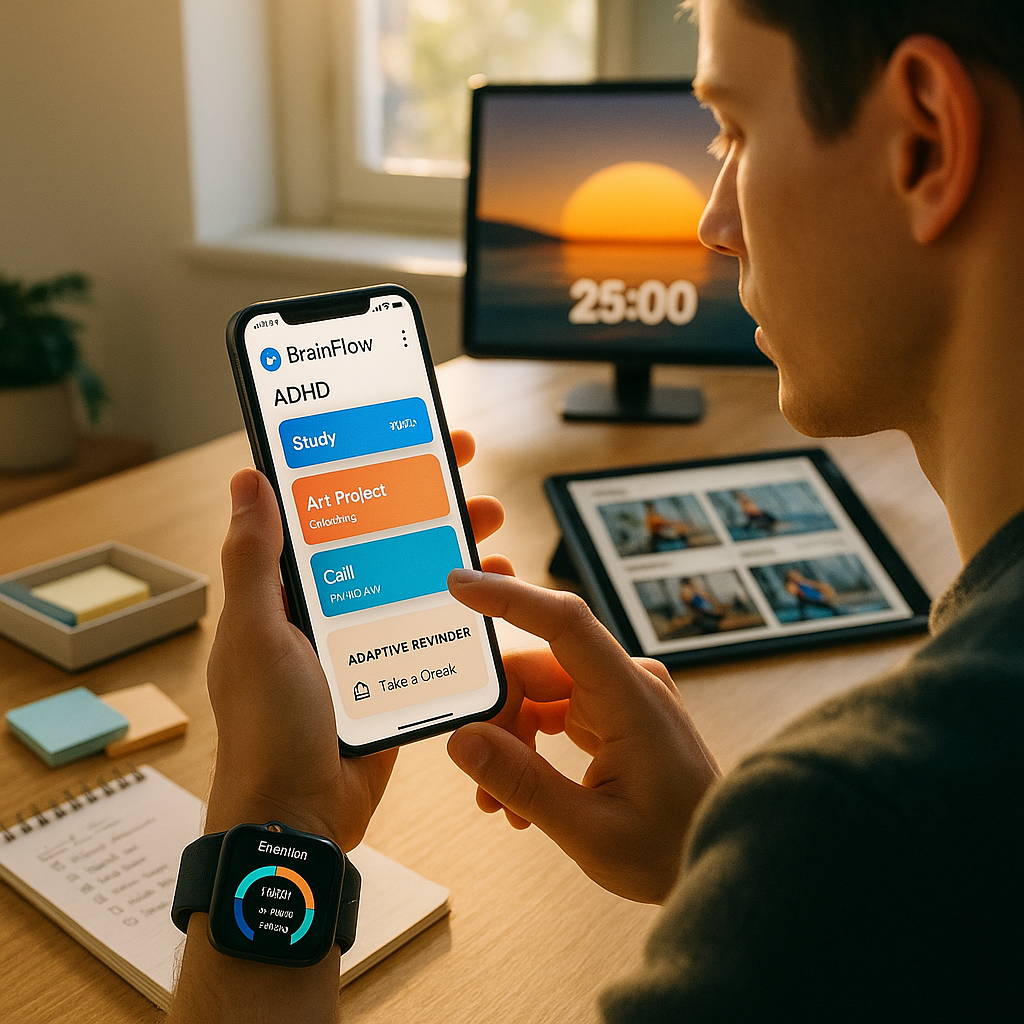
BrainFlow, a new AI-based task management app created specifically for individuals with ADHD, launched today after two years of development with neurodivergent programmers and ADHD specialists. The app offers adaptive reminders that adjust to user response patterns, context-aware priority sorting, and emotion tracking to help identify when executive function challenges arise.
Early users have reported notable improvements in task completion rates compared to standard productivity tools. Dr. Maya Richardson, lead researcher for the BrainFlow project, stated that traditional apps assume neurotypical executive function. She said that BrainFlow was developed from the start with the ways ADHD brains process information and manage attention in mind.
BrainFlow provides tiered subscription options, starting with a free version covering core features. A premium upgrade adds personalized coaching and integration with other productivity tools. User data is anonymized, and participants can choose to contribute information for research into ADHD management, supporting ongoing product refinement and academic study.
Also Today. Research Developments
Evening screen time reduces medication effectiveness
Recent research published in the Journal of Attention Disorders finds that evening screen time may significantly impact medication effectiveness for individuals with ADHD. In this multi-center study, 340 participants were observed over six months, monitoring both stimulant medication results and evening technology use.
Participants who used screens within two hours before bed reported their medication was 23% less effective the next morning compared to those who avoided evening screen time. Dr. James Kowalski, lead researcher, indicated that blue light exposure disrupts sleep quality and dopamine regulation systems essential for effective medication response.
Researchers advise establishing a “digital sunset” at least 90 minutes before intended sleep time to boost treatment benefits. They are also planning follow-up studies to determine if specific types of screen usage are more disruptive than others.
Structured exercise programs show significant benefit for adults
A 12-week randomized controlled trial compared structured exercise routines with standard ADHD treatments, revealing significant benefits when combining both approaches. Conducted across five university research centers, the study included 275 adults with ADHD, allocated to medication-only, exercise-only, or combination treatment groups.
The combination treatment group demonstrated a 37% greater improvement in executive function skills than the medication-only group. Dr. Lisa Zhang, principal investigator, stated that the strongest benefits occurred in working memory and impulse control, emphasizing that program structure, rather than exercise intensity, was the key factor.
Despite the positive outcomes, program adherence proved challenging. The research team is now developing smartphone-based coaching tools to increase long-term engagement with physical activity.
Genetic mutations may explain medication response differences
Researchers at Stanford University have identified three previously unknown genetic mutations that could help explain why some individuals with ADHD respond differently to stimulant medications. As presented in Nature Neuroscience, the study analyzed the genetics of 1,820 participants with varying medication responses.
These mutations affect dopamine transporter mechanisms and may clarify why about 30% of patients achieve limited results with first-line medication. Dr. Sanjay Patel, co-author and geneticist, stated these findings could shift approaches to medication selection and advance precision medicine for ADHD.
While clinical applications may take several years, the research group is collaborating with pharmaceutical firms to create screening tests that predict medication response before treatment. This could reduce the current trial-and-error process in ADHD care.
What to Watch. Key Dates and Events
- The National Institute of Mental Health will release comprehensive guidelines on technology use for neurodivergent individuals on 15 December 2025, following three years of multi-disciplinary research.
- Results from the FOCUS-ADHD clinical trial testing a new non-stimulant medication will be published in the American Journal of Psychiatry on 12 January 2026 and are expected to inform options for treatment-resistant ADHD.
- The International Conference on Neurodivergence and Technology is scheduled in Boston from 3 to 5 February 2026, with sessions on emerging digital solutions for ADHD management.
Conclusion
Recent advances in ADHD news and research emphasize the growing role of technology and lifestyle factors in personalizing treatment and daily management. AI-driven task management apps, genetic discoveries, and evidence supporting exercise all expand options for neurodivergent individuals. What to watch: release of technology use guidelines by the National Institute of Mental Health on 15 December 2025 and results from major clinical trials in early 2026.



Leave a Reply