

Key Takeaways
- Transform hyperfocus into a creative superpower without crashing: Intentional routines allow bursts of inspiration to be channeled productively, while carefully placed safeguards help prevent that slide from being “in the zone” to total exhaustion.
- Make time work for your brain, not against it: ADHD-friendly strategies like time blocking and energy pattern tracking help creatives align their most demanding work with peak focus hours, leaving slower times for recovery or administrative tasks. This approach applies not just in design, but in industries like healthcare (for focused patient care), marketing (optimal campaign ideation), and education (deep-dive curriculum planning).
- Defend your boundaries with scripts and systems: Firm yet compassionate boundaries with clients, using communication templates and planned “buffer zones,” ensure that last-minute requests or endless revisions never derail your workflow or encroach on your necessary downtime.
- Prioritize recovery as a core creative process, not an afterthought: By structuring in “creative detox” sessions, movement, and intentional downtime, rest becomes a planned ingredient of the creative cycle, reducing guilt and making recovery routine. This model benefits not only designers, but also legal professionals (combating document fatigue) and finance experts (avoiding analysis burnout).
- Turn ADHD traits into professional assets: Risk-taking, curiosity, and rapid problem-solving can be reframed as a powerful toolkit for innovation and enhanced value. These are traits highly prized in fast-moving sectors, from tech startups to environmental science initiatives.
- Balance structure and flexibility for sustainable growth: Combining reliable scaffolding (like project trackers, checklists, and automated reminders) with permission for creative pivots empowers ADHD minds to scale without burning out. This approach is widely applicable across project management, retail, and consulting roles.
- Leverage vulnerability for radical professionalism: Sharing personal challenges openly with collaborators and clients builds trust and sets honest expectations, redefining what it means to be “professional” as a neurodivergent creative.
This case study breaks away from generic advice and reveals how embracing the reality of ADHD, in all its messy brilliance, powers a sustainable, rewarding design career. Now, let’s dive into the real story, strategies, and lived experience that help transform chaos into a competitive edge.
Introduction
Every creative professional with ADHD recognizes the thrilling pull of a project that launches them into deep hyperfocus, followed by the unseen crash that often comes when deadlines fade and notifications keep piling up. In design, juggling ambitious projects, personal passions, and necessary recovery isn’t merely a productivity challenge. It’s an ongoing negotiation with the unique wiring of your brain.
This ADHD creative case study traces one designer’s journey through these daily tensions: channeling intense inspiration into a genuine superpower, building ADHD-friendly routines to preserve recovery time, and establishing boundaries that protect downtime from client or project demands. We’ll explore practical, real-world systems (including scripts, templates, and rituals) that transform ADHD’s chaos into a powerful toolkit for lasting success.
The Unique Relationship Between ADHD and Creative Design Work
Creative professionals with ADHD occupy a remarkable crossroads where their neurodivergence equips them with exceptional capabilities, but it also introduces distinct hurdles. This dynamic requires nuanced strategies, specialized tools, and most importantly, a mindset that embraces their differences as valuable assets.
The Double-Edged Sword of Hyperfocus
Within creative professions, the phenomenon of hyperfocus for ADHD individuals is both a signature advantage and a potential downfall. Unlike typical “flow states,” ADHD hyperfocus presents several defining characteristics:
- Intensity and duration: Many ADHD creatives report entering single-minded focus for 6-12 hours at a stretch, often forgetting to eat, move, or take breaks.
- Quality and innovation: These focused stretches frequently deliver the designer’s most inspired, nuanced work, unlocking solutions that others might overlook.
- Heightened recovery needs: The neurological cost of intense focus is substantial. Without deliberate rest protocols, the aftermath is mental depletion and diminished creativity.
A graphic designer captured this experience vividly:
“When I’m absorbed in a branding project, connections appear that others miss. I’ll brainstorm 30 concepts where most create 10. Afterwards, though, I’m completely drained. It’s like running a marathon in my mind.”
This cyclical pattern—rising waves of creativity followed by deep fatigue—means ADHD creatives must plan for structured recovery as an integral part of their process, a reality often invisible in standard productivity advice for the creative sector.
Industry Demands vs. ADHD Processing
Design and other creative industries are often structured in ways that clash with how ADHD brains process information and manage time:
- Simultaneous client demands: Designers frequently juggle 3-7 active projects, each requiring focused attention and unique feedback loops.
- Relentless context-switching: Switching between distinct brand guidelines, creative directions, or technical requirements drains cognitive reserves, especially for neurodivergent minds.
- Deadline-centric workflows: While some ADHD creatives are energized by deadlines, the combination of urgency and variable time perception can fuel both laser focus and anxiety.
- Ambiguous briefs: What feels like creative freedom to some can be paralyzing for those who need clear direction and actionable parameters.
When unmanaged, these systemic pressures can result in burnout, missed deadlines, or creative paralysis. However, reframing these challenges as opportunities to implement tailored systems can transform friction into an advantage not just in design, but in areas like healthcare (navigating complex patient cases) or finance (managing shifting priorities amid regulatory changes).
The crucial insight here is that neurodivergent creative success has little to do with “fixing” a problem. It’s everything to do with designing workflows that amplify strengths and plan for predictable pitfalls. This strategic reframing forms the basis for sustainable, fulfilling careers across all creative sectors.
Systems for Harnessing Hyperfocus in Design Work
ADHD creatives achieve long-term success not by taming their hyperfocus, but by engineering work environments to channel it purposefully. This proactive approach turns potential chaos into repeatable, high-caliber output.
Energy Mapping for Optimal Creative Output
Smart scheduling isn’t just about reacting to deadlines. For ADHD professionals, mapping when their energy peaks and dips is a transformative practice:
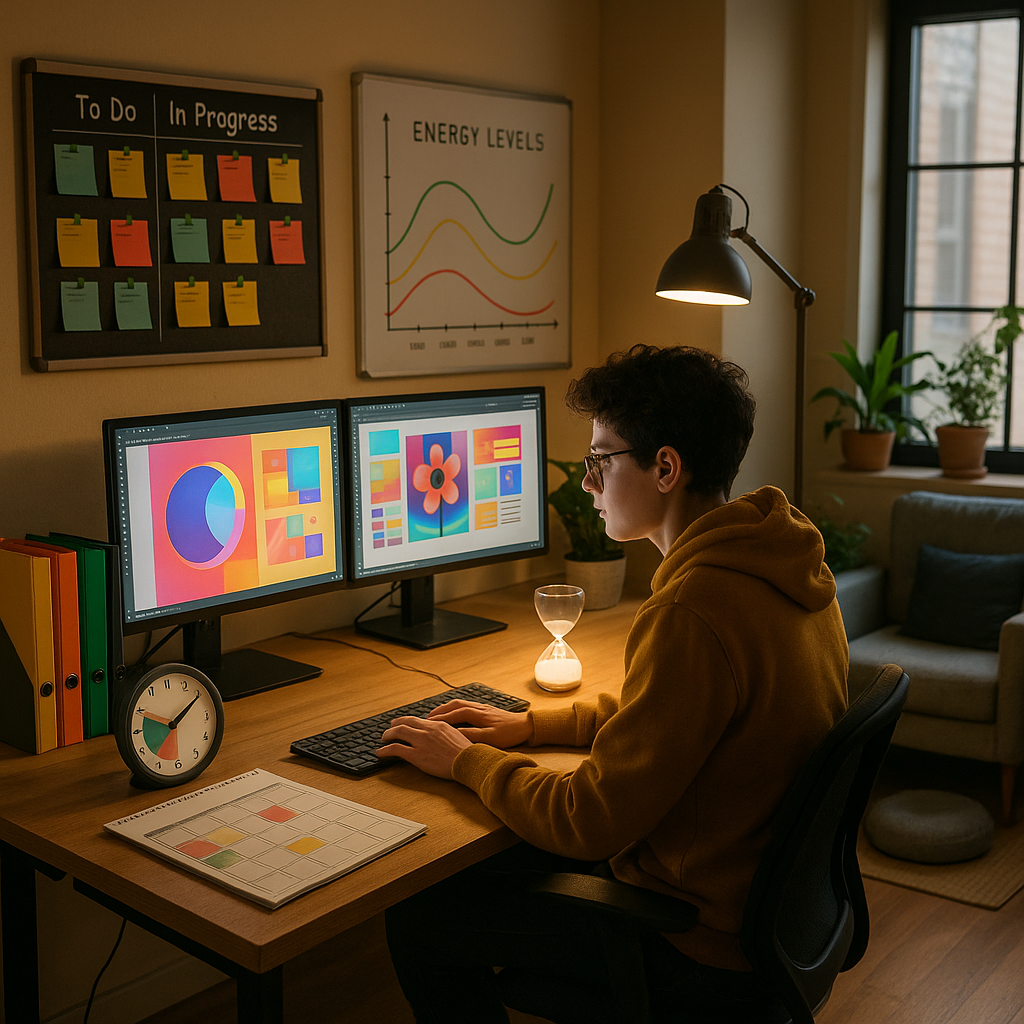
- Track your natural rhythm: Monitor periods of creativity, focus, and fatigue using journals or tracking tools. This data informs scheduling for weeks and months ahead.
- Align intense tasks with high energy: Reserve peak hours for deep creative work, like brainstorming, first drafts, and conceptual design, while shifting admin or routine work to slower times.
- Apply across professions: In healthcare, this might mean focusing on complex diagnostics during peak alertness. In education, it helps plan challenging lessons in alignment with both student and teacher energy.
A UI/UX designer described the impact of energy mapping:
“10 AM to 2 PM is my creative window. I block it out for design, then handle emails and meetings later when my focus naturally drops. Not only did my work improve, but I found myself recovering faster after big projects.”
Structured Design Sprints for Controlled Hyperfocus
Rather than resisting the urge to deep-dive, ADHD creatives can benefit from working within clear boundaries:
- Pre-load all essentials: Before starting a sprint, compile references, feedback, and assets to eliminate context-switching.
- Define concise, objective goals: Rather than vague direction (“Work on website”), state clear outcomes (“Produce three homepage drafts”).
- Use extended Pomodoro cycles: ADHD brains may benefit from longer, focused blocks (40-50 minutes) with built-in, non-negotiable breaks.
- Leverage physical cues and tech: Visual timers, alarms, or focus apps ensure scheduled breaks actually happen.
A brand designer shared,
“Timers used to interrupt my flow until I saw them as safeguards, not barriers. Forty-five minutes of work followed by a real break kept my ideas sharp. My clients noticed better quality, and I avoided post-sprint burnout.”
Project Pacing and Parallel Processing
Sequential work can sometimes feel stifling, and ADHD brains often excel with structured multi-tasking:
- Project rotation: Rotate between 2-3 active tasks each day. Stepping away from one project often unlocks solutions for another.
- Track progress visually: Kanban boards, mind maps, or project management apps help keep multi-project momentum visible.
- Practice strategic procrastination: Schedule creative pushes to align with moments when a manageable sense of urgency will activate best performance, while still maintaining responsible timelines.
An art director explained,
“By rotating between branding projects, I bring a fresh perspective each time I switch gears. Sometimes what feels like distraction is actually my best asset—I solve problems when I return to them with new eyes.”
These systems turn what can seem like disorder into a uniquely powerful workflow. This echoes success stories from customer support, product development, and scientific research fields, where structured pivoting drives breakthroughs.
Setting Boundaries as an ADHD Creative Professional
Creating and maintaining boundaries is essential for ADHD professionals. This is vital not just for time management, but for protecting creative and cognitive energy. It’s particularly important in fields with fast-paced client interaction, such as consulting, legal services, and healthcare.
Client Communication Scripts and Templates
To ensure consistency and reduce in-the-moment stress, establishing pre-written templates is effective:
Project Scoping Email:
Thank you for outlining your project vision. I recommend we approach this in clearly defined phases:
Phase 1: [Deliverable] by [Date]
Phase 2: [Deliverable] by [Date]
My process includes two rounds of revisions per deliverable. Extra revisions can be scheduled at an additional rate.
I dedicate specific days/times to client communication, which allows me to give undivided creative attention during design sessions.
Boundary Reinforcement Message:
Thank you for your enthusiasm around this project. To ensure I maintain creative quality, I manage new requests during planned review sessions.
If you require more immediate updates or changes, we can discuss adjusting the project scope or timeline at our next checkpoint.
A web designer noticed a positive shift:
“Templates took the pressure off during difficult conversations. Instead of agreeing to every request, I set realistic expectations early. Clients respected my process much more.”
The Traffic Light System for Managing Capacity
Many ADHD professionals struggle with overcommitment. The traffic light approach brings clarity:
- Green: Fully available, new projects and opportunities welcome.
- Yellow: Selective acceptance, limited space, only strategic or particularly meaningful work.
- Red: Fully committed, no new work until current commitments are fulfilled.
To implement effectively:
- Post your status visually in your workspace.
- Update weekly during project reviews.
- Consult this status before committing to new requests.
- Share status transparently with regular collaborators.
An illustrator reflected,
“This system gave me structure. When I was in the ‘yellow’ or ‘red’ zone, I let agents and clients know. The clarity improved both my reputation and my well-being.”
Structured Collaboration and Role Clarity
Collaborative projects can be energizing but also overwhelming without defined roles and communication windows:
- Schedule feedback sessions in advance: Specify times for input instead of accepting constant messages.
- Outline roles up front: Use visual documentation or checklists to clarify who is responsible for each part of the project (helpful for teams in technology, healthcare, and education as well).
- Establish protocols for revisions: Set expectations for how and when changes can be requested, further reducing cognitive fatigue.
- Block “deep work” windows: Communicate when you will be unavailable for meetings or feedback, preserving essential creative energy.
This approach can be adapted by professionals across industries. Attorneys can clarify document review windows, educators can specify times for parent communications, and marketers can designate campaign planning hours.
Conclusion
The vibrant connection between ADHD and creative design is both an engine for innovation and a source of real-world challenges. By redefining hyperfocus as a strategic advantage, ADHD professionals unlock a core superpower. However, this potential is only realized when paired with energy management practices, structured workflows, and transparent boundaries. Strategies like energy mapping, project pacing, design sprints, and scalable templates turn perceived weaknesses into game-changing strengths. And not just in design, but in any sector valuing agility and creativity.
The central lesson for neurodivergent professionals is that success isn’t about conforming to conventional productivity models. Instead, it’s about designing systems and environments that amplify individual strengths and honor natural rhythms. When ADHD creatives tailor their workflows to their brains, they create a foundation for not just surviving, but actively excelling in industries hungry for fresh ideas and resilient problem-solvers.
Looking forward, as more organizations and industries recognize the value of neurodiversity, those who boldly rethink workflow and openly champion their unique perspectives will be the ones shaping the future. The new frontier of creative work belongs to those who aren’t just adapting. They are leveraging what makes them different as their ultimate advantage. Whether in design, business, science, or education, the question is not if you can thrive with ADHD, but how you will architect your environment to make your brilliance undeniable.


Leave a Reply