
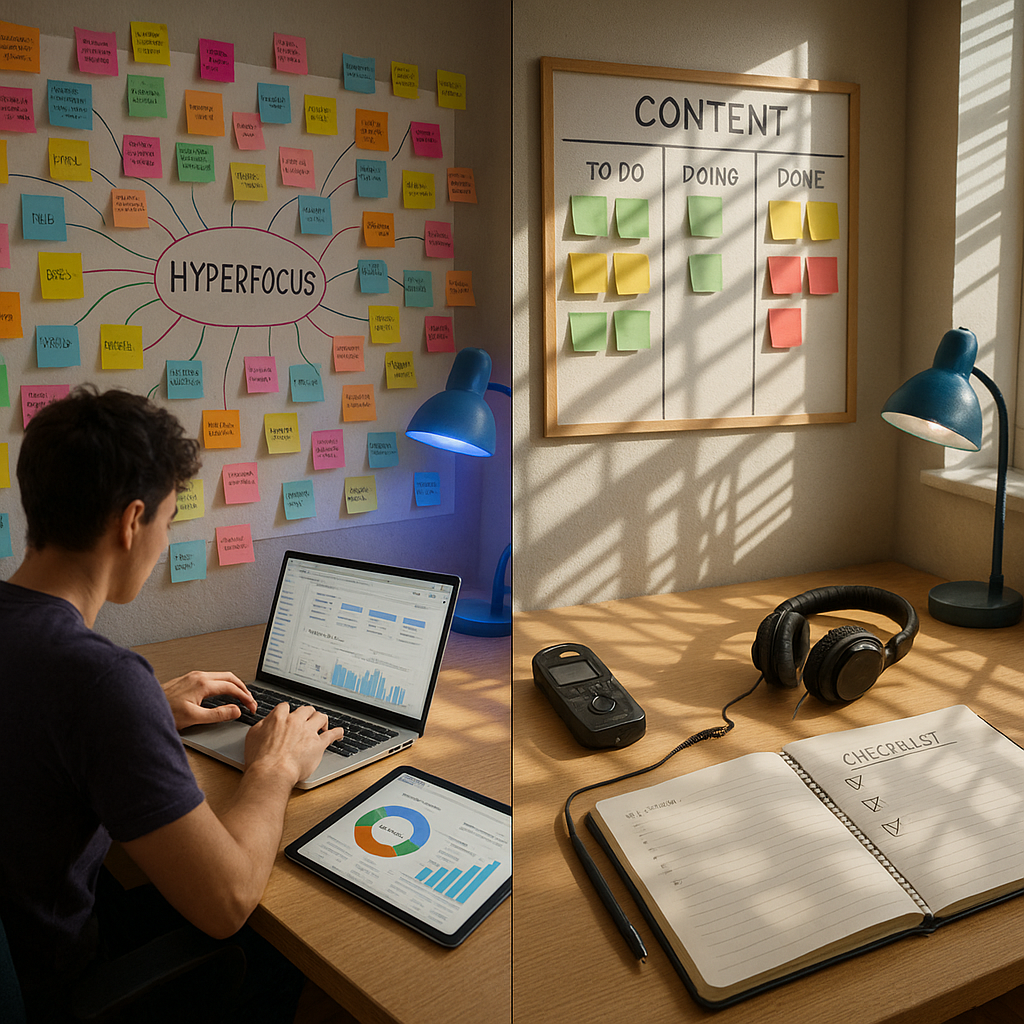

Key Takeaways
- Design workflows for the ADHD cycle, not against it: Sustainable systems recognize the natural peaks and valleys of ADHD motivation. By embracing bursts of hyperfocus and intentionally building buffers for inevitable slowdowns, you avoid unrealistic expectations of relentless consistency.
- Embrace flexible content schedules over rigid calendars: Replace brittle publishing routines with adaptable, batchable task blocks. This approach allows you to ride creative waves when they come and maintain progress when energy dips, supporting long-term momentum while reducing guilt over “missed” days.
- Reduce decision fatigue with visualized, repeatable steps: Use simple, ADHD-friendly checklists, visual templates, and “just start” triggers. These strategies make it easier to begin content sessions and transform chaotic beginnings into reliable habits that become second nature.
- Batch, automate, and sequence tasks for focus: Minimize context switching by grouping SEO, writing, and publishing tasks into dedicated sprints or specific days. Aligning your energy and attention with focused task blocks helps prevent scattered efforts and fosters deep work.
- Use apps as scaffolding, not crutches: Support ADHD workflows with tools and automations that gently guide your process rather than overwhelm you. Select platforms like Notion or Trello for visual planning, or AI assistants for repetitive SEO tasks, while keeping systems adaptable to accommodate shifting interests.
- Make imperfection your superpower: Let go of perfectionism in favor of progress. Incorporate feedback loops and minimal-viable drafts into your routine so you move content forward even when self-doubt arises. Progress, not unattainable perfection, is the engine of consistency.
- Celebrate publishing consistency, not just performance metrics: Prioritize showing up and regularly publishing your work over obsessing about rankings or reach. Consistent, incremental publishing, however imperfect it feels, is the true hallmark of a sustainable ADHD-friendly SEO workflow.
- Transform burnout into a productivity reset, not a failure: Recognize that rest and recovery are essential steps in the creative process. Establish rituals for creative recovery and re-entry so it’s easier to pick up where you left off, replacing guilt cycles with proactive resets.
By adopting these ADHD-tested strategies, you’ll learn to harness your strengths, avoid common pitfalls, and build a content creation process that works in harmony with your neurotype. Now, let’s explore actionable stories, tools, and templates that empower you to create and publish effectively on your own terms.
Introduction
You sit in front of a blank Google Doc. Dozens of half-written drafts linger on your desktop. One moment, you’re in an electric burst of hyperfocus. The next, that energy vanishes just when steady progress matters most. For ADHD content creators, these dramatic swings between creative flow and overwhelmed inertia aren’t just quirks; they’re the foundation of your working style.
But forcing yourself into rigid productivity molds isn’t the answer. Instead, building an ADHD-friendly SEO workflow and publishing system that bends with your brain’s rhythms allows you to capitalize on creative highs, reduce decision fatigue, and finish projects. Get ready to discover practical tools, relatable strategies, and compassionate routines that make publishing possible, no matter how unpredictable your mind feels.
Understanding the ADHD Content Creation Challenge
Establishing a consistent content schedule can be a challenge for anyone, but for creators with ADHD, the journey can feel like scaling a mountain with unpredictable weather. Standard advice such as “just pick a schedule” or “batch all your content on Mondays” doesn’t account for the unique dynamics of ADHD brains.
The Cycle of Hyperfocus and Burnout
The ADHD content creation process often follows a repeating cycle:
- Inspiration Phase: A new idea sparks excitement, triggering a period of intense hyperfocus. You might produce several content pieces in quick succession, fueled by passion and clarity.
- Depletion Phase: The well of motivation suddenly runs dry. The task that once captivated you now feels heavy and tedious.
- Guilt/Recovery Phase: As publishing consistency falters, guilt creeps in. You criticize yourself for “failing again”, while your brain desperately seeks rest.
- Restart Phase: Eventually, a new spark ignites, and the cycle begins anew.
This cycle is not a flaw. It’s deeply rooted in ADHD neurochemistry. Most mainstream content advice assumes creators have a steady, predictable supply of interest, energy, and executive function, which clashes with how ADHD minds actually work.
Why Traditional Publishing Systems Fail ADHD Creators
Standard publishing calendars and systems often fall short for ADHD creators for several reasons:
- Assumption of level energy: They expect a consistent daily output, ignoring the natural peaks and lows typical of ADHD brains.
- Sustained attention required: These systems count on ongoing focus on specific topics, even as interest or dopamine fades.
- Rigid timeframes: Traditional calendars rely on strict deadlines and time awareness, which clashes with common ADHD time blindness.
- Linear task progression: They presume tasks will progress in order, even as ADHD minds frequently work non-linearly and follow inspiration over structure.
Recognizing these patterns is the first step toward building a workflow that works with your brain, not against it. When you stop fighting your unique neurotype and instead develop systems that accommodate it, sustainability and satisfaction increase.
Creating an SEO Framework That Accommodates ADHD Cycles
Sustainable content creation for ADHD doesn’t hinge on sheer discipline or finding a magical app. The foundation is a flexible, adaptable system that shifts with your natural rhythm, still supporting your SEO and publishing goals.
Designing Your Flexible Content Pipeline
Instead of rigid week-to-week content planning, construct a modular content pipeline with distinct phases:
- Idea Capture Zone: Establish a low-friction way to collect ideas anywhere, anytime, whether through a voice recorder, mobile notes, or sticky notes.
- Research & Outline Bank: Build a repository of partially developed ideas and outlines, ready for quick activation during hyperfocus phases.
- First Draft Factory: Channel bursts of energy into drafting rough versions during high-motivation moments.
- Polish & Publish Station: Dedicate time to refining, optimizing for SEO, and scheduling content when your energy is moderate.
Using this workflow lets you jump between stages for different pieces based on your current state, freeing you from an “all-or-nothing” start-to-finish process.
Harnessing Hyperfocus for Maximum Output
Hyperfocus is a creative superpower when channeled strategically. To make the most of it:
- Maintain a “Next Hyperfocus Hit List”: Identify high-value content tasks in advance, so you seize the moment when inspiration hits.
- Set up topic clusters: Create a bank of related content themes so you can tackle groups of pieces in a single session, making your bursts of productivity efficient and cohesive.
- Develop templates: Use flexible templates to reduce decisions and focus creative energy where it matters most.
- Try voice-to-text tools: Capture fast-moving thoughts with audio notes or dictation apps, especially helpful when ideas flow faster than you can type.
Preparing for hyperfocus unlocks the ability to produce weeks’ worth of content in a single surge, giving you a buffer to carry through slower periods.
Building Recovery Periods Into Your Workflow
Recovery isn’t failure. It’s essential maintenance. Make recovery periods an intentional part of your system:
- Schedule “fallow periods”: Block out time for rest after creative sprints, just as you would for writing or publishing.
- Assign light tasks on low-energy days: Opt for activities like image sourcing, linking, or simple edits.
- Apply a “minimum viable publishing” template: Have a stripped-down format for days when you can only do the basics, ensuring output even when motivation is low.
- Partner up: Collaborate with others to swap tasks or provide support when your energy is depleted.
By embracing recovery, you support your workflow’s sustainability and maintain momentum.
SEO Strategies Optimized for the ADHD Mind
For many ADHD creators, SEO can feel like a maze of tedious checklists and technical details. The key is to adapt SEO methods so the process becomes inviting and manageable.
Visual Keyword Research Techniques
Spreadsheets full of keywords often trigger overwhelm. Instead, leverage these ADHD-friendly, visual approaches:
- Mind mapping tools: Use platforms like MindMeister or XMind to map out keyword relationships visually.
- Color-coding systems: Assign colors to topics, intent, or competition levels for instant clarity.
- Visual Trello or Notion boards: Organize keyword cards that can move between “idea,” “research,” and “in draft” columns.
- Bubble cluster diagrams: Visualize related keywords grouped together, helping you spot gaps or opportunities at a glance.
Visual methods tap into the ADHD love of pattern and spatial problem-solving, making research feel creative instead of monotonous.
Chunking SEO Tasks to Reduce Overwhelm
Break SEO work into stand-alone, bite-sized actions for quick wins and steady dopamine feedback:
- Title optimization: Focus entirely on crafting a keyword-rich headline.
- Heading structure: Arrange H2s and H3s to incorporate secondary keywords.
- Image optimization: Rename files and add alt text with relevant phrases.
- Meta description: Build a compelling, concise snippet with main terms.
Treat each element as a separate task, spreading them out or stacking them together during high-focus windows. Simple checklists for each phase provide prompts and satisfying visual progress.
Tools That Reduce SEO Cognitive Load
The right tools turn complex steps into guided, streamlined processes:
- RankMath or Yoast: Get instant feedback and color-coded recommendations inside your writing platform.
- Frase.io or SurferSEO: Real-time optimization guidance so you don’t have to leave your draft to check for SEO best practices.
- AI writing assistants: Tools like Jasper help generate or refine SEO-friendly content when your focus wanes.
- Notion or Airtable databases: Visually organize keyword research in customizable, easy-to-navigate layouts.
These platforms automate many small steps, freeing up energy for creativity and decision-making while maintaining SEO quality.
Creating Visual Content Schedules That Actually Work
Standard editorial calendars can amplify guilt and overwhelm for ADHD creators. To build a sustainable system, reimagine scheduling through the lens of visual cues and flexible planning.
Beyond the Traditional Editorial Calendar
Replace rigid, date-driven calendars with adaptable, visual-first systems:
- Content Pool System: Maintain a library of nearly-finished pieces ready for release when energy peaks, rather than tying each to a strict date.
- Traffic Light Schedule: Classify content as green (ready to go), yellow (minor tweaks needed), or red (ground-floor stage) for instant clarity on what’s next.
- Module Board: Sort projects by completion stage instead of publish dates, letting you “pull” the next task as capacity allows.
- Sprint Approach: Run focused 1–2 week work sprints, followed by strategic downtime for reset and reflection.
These structures enable burst-driven productivity instead of penalizing natural ebb and flow.
Visualizing Progress Without Time Pressure
To spark motivation and track movement, lean on visuals over timelines:
- Physical Kanban boards: Move cards from “idea” through “done”; seeing movement is its own reward.
- Progress bars: Chart completion in percentage or steps rather than due dates.
- Color-coded status markers: Instantly see at a glance what’s closest to publication.
- Notion or ClickUp dashboards: Visualize workflows and milestones, focusing on progress rather than deadlines.
By making progress visible, you replace deadline anxiety with a rewarding sense of momentum.
Balancing Structure with Flexibility
The right workflow blends order and adaptability:
- Theme days: Assign days to a broad area (like “Strategy Fridays”) instead of specific tasks, leaving room for energy fluctuations.
- 3-tier priority system: Label content as “must publish,” “want to publish,” or “bonus,” clarifying focus each week.
- Interchangeable content blocks: Swap in the most appealing project during each session, reducing resistance and decision fatigue.
- Buffer content: Maintain an always-ready stash to fill gaps and keep your publishing streak alive.
These methods keep you organized without boxing you into rigid demands, supporting motivation and reducing burnout risks.
Expanding Beyond Content Marketing: ADHD-Friendly Workflows in Other Industries
While content creation is a common struggle for neurodivergent creatives, flexible, visual, and cyclical workflows can benefit professionals across many fields:
- Healthcare: Implement visual patient management boards that adapt to high-pressure shifts, using automation tools for appointment reminders and documentation during downtime.
- Finance: Use color-coded dashboards and automated transaction categorization, turning complex portfolio reviews into manageable sprints during periods of high focus.
- Education: Introduce modular lesson planning and adaptive learning materials so teachers and students can batch learning or grading tasks based on energy and engagement.
- Legal: Break down contract drafting and review into visual checklists, employing AI-powered compliance monitoring to automate repetitive steps.
- Marketing & E-commerce: Batch ad campaign planning or inventory audits, automate analytics reporting, and use visual boards to track copy revisions and trend research in fast-evolving markets.
- Environmental Science: Use project management tools to coordinate climate modeling tasks, scheduling data analysis in sprints and building in recovery periods for field researchers.
- Consumer Services: Deploy visual customer feedback tools and modular follow-up systems, automating reminders but keeping hands-on care adaptable to service provider bandwidth.
No matter the industry, embracing ADHD strengths (pattern recognition, creative bursts, and adaptability) leads to more resilient, sustainable workflows for neurodivergent and neurotypical professionals alike.
Conclusion
Traditional advice often fails ADHD content creators by overlooking the brain’s innate cycles of energy, creativity, and rest. By embracing flexible pipelines, preparing for both surges of hyperfocus and essential recovery periods, and leveraging visual, modular tools, neurodivergent professionals can shift from shame-driven chaos to a workflow that feels authentic and sustainable. Approaches like mind mapping keywords, breaking SEO into manageable actions, and using progress-driven boards can transform content creation from a source of anxiety into a dynamic space for creative problem-solving.
This philosophy extends well beyond publishing. In healthcare, finance, education, and other fast-paced sectors, ADHD-friendly systems fuel consistent output, deeper engagement, and stronger results. Looking ahead, individuals and businesses that design with neurodiversity in mind—who choose workflows inviting progress over perfection—will turn what once felt like obstacles into unmatched strengths. Success in the coming era will belong to those who leverage neurodivergent brilliance, not by forcing conformity, but by empowering each mind to work its way.
If you’re ready to leave guilt behind and let your workflow spark creativity and consistency, remember: your operating system isn’t broken, it’s brilliant. The challenge is no longer how hard you force yourself to fit in, but how intentionally you design systems that let your mind shine. The future of productivity belongs to those who dare to work with, not against, their neurotype.




Leave a Reply