

Key takeaways
- Body doubling means doing a task while another person is present, in the room, on a video call or on a recording.
- The term comes from neurodivergent communities. In a 2024 survey of 220 people, many recognized it as something they had been doing for years without a name for it.
- The research is young. A peer-reviewed study that measured performance (2025, 26 participants, EEG) found no statistically significant difference, and no consistent harm.
- It tends to help most with routine tasks you already know how to do, and less with complex, unfamiliar work. That matches what social psychology has said about the presence of others since 1965.
- It costs little to test: one week, a few sessions, a written note after each one.
The email you could not start
You have been at your desk for half an hour. There is one email you need to send. You know exactly what it should say. You open it, look at it, and end up somewhere else: a feed, a video, a tab you do not remember opening.
Then a friend sits down across the table with their own laptop. They do not help you. They do not even look at your screen. Ten minutes later the email is sent.
That shift has a name in ADHD communities: body doubling. This guide explains what it is, why it might work, what the research really shows (less than the internet suggests), and how to test it on yourself.
What body doubling is
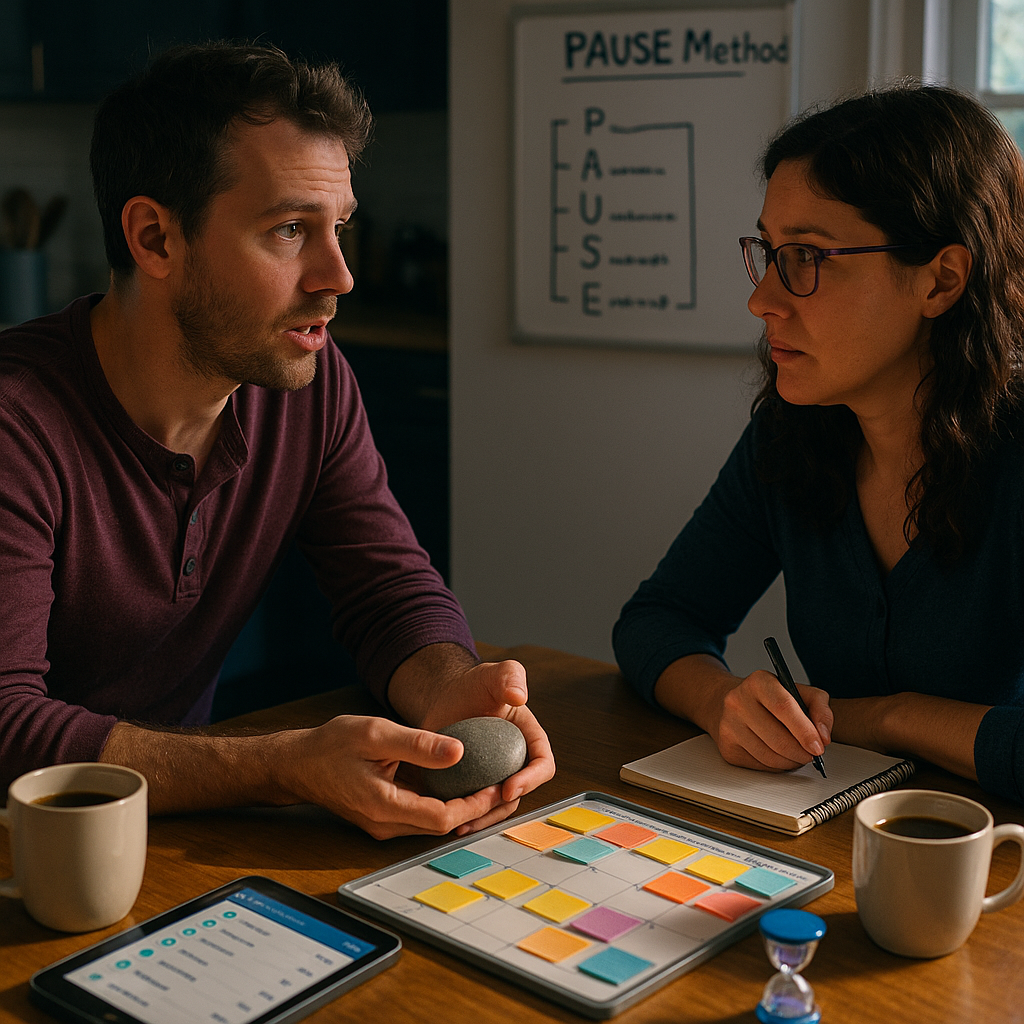
Body doubling means doing a task while another person is present. The other person is usually doing their own work. They are not coaching you, and often they are not talking at all.
A detailed description comes from a team at the University of California, Santa Cruz. They surveyed 220 people about how, when and why they body double. The community, they write, roughly defines it as “using the presence of others to start, stay focused on, or accomplish a task.” A body double can be in the same room or remote, live or recorded, someone you know or a stranger (Eagle, Baltaxe-Admony & Ringland, 2024).
The same study found that the practice “remains nameless to many neurodivergent individuals.” Once people heard the term, many recognized it as a strategy they had used for years. People body doubled in cafés and with YouTube videos, for studying and work, but also for dishes, cleaning and exercise. Their reasons were practical: generating momentum, staying on task.
The researchers describe body doubling along 2 dimensions (Eagle et al., 2023):
- Space and time. From a person in the same room right now, to a video call, to a recorded “study with me” video.
- Mutuality. From someone who barely knows they are your body double, like a stranger at the next café table, to a partner who knows the arrangement and expects to hear what you got done.
Why it might work
Nobody has proven the mechanism yet. But 3 lines of research make it plausible.
1. The presence of others changes how we perform. In 1965 the psychologist Robert Zajonc pulled together decades of experiments on “social facilitation.” His conclusion was that the presence of others raises arousal, and that this helps with simple or well-practiced tasks and hurts with complex or unfamiliar ones (Zajonc, 1965). That is a useful map for body doubling: it should help most with the email you already know how to write, and least with the problem you have never solved before.
2. Procrastination is about the task as much as the person. A large meta-analysis of 691 correlations found that strong and consistent predictors of procrastination included task aversiveness, task delay, self-efficacy and impulsiveness (Steel, 2007). Boring tasks with a distant payoff are exactly the ones people with ADHD describe as hardest to start. A body double does not make the task less boring, but it adds something happening right now.
3. The ADHD reward system works differently. A brain imaging study of 53 unmedicated adults with ADHD and 44 controls found lower dopamine markers in the brain’s reward pathway, and those markers correlated with attention ratings (Volkow et al., 2009). That study says nothing about body doubling directly. What it supports is the broader idea that “just get started” is harder for an ADHD brain, and that outside structure can make up some of the difference.
What the research actually shows
This is where the evidence gets thinner.
- How people use it: well described. The 2024 survey of 220 people documents how and why people body double. It does not measure whether they finish more (Eagle et al., 2024).
- Measured effect: not shown yet. In 2025, researchers had 26 participants, people with ADHD (medicated and unmedicated) and neurotypical controls, take 2 reading comprehension tests, one with a body double and one alone, while EEG tracked focus and calm. The results “did not show statistically significant differences” between the 2 conditions. The authors also saw “no consistent negative impacts across groups and promising trends for unmedicated ADHD participants,” and called body doubling “a safe strategy that warrants further investigation” (Schuenke, Dickenson & Moore, 2025).
- Early experiments: promising, not peer reviewed. A 2025 preprint tested a construction task in virtual reality with 12 participants. They finished faster with a human or an AI body double than alone, and reported better accuracy and sustained attention (Ara et al., 2025). It is a small study that has not been peer reviewed yet.
So the honest summary is this: many people with ADHD report that body doubling helps, it appears to be safe, and science has not yet shown how much it helps or for whom. That is a good reason to test it on yourself instead of taking anyone’s word for it, including ours.
How to set it up
Choose your format
- In person. A friend, partner or coworker doing their own work at the same table. A library or café works as a low-mutuality version.
- Video call. A friend on a call with cameras on and microphones muted.
- Matched sessions. Services like Focusmate pair you with a stranger for a scheduled session: you each say what you will work on, work in silence, and report at the end. At the time of writing (November 2026), Focusmate’s free plan includes 3 sessions a week, and its Plus plan costs $8 a month billed annually or $12 billed monthly (Focusmate pricing).
- Recorded. “Study with me” or “work with me” videos. This is the lowest-mutuality format: nobody knows you are there, but some people find that enough.
Use a simple structure
- Check in, 30 seconds. Say, or type, the one task you will do. Make it concrete: “send the invoice to Sam,” not “admin.”
- Work in silence. Cameras on if remote, notifications off.
- Check out, 30 seconds. Say what you actually did, even if it is less than planned.
Pick the right tasks
Based on the social facilitation pattern above, start with tasks you already know how to do and simply avoid:
- email, invoices, forms and other admin
- a first draft you have already outlined
- tidying, laundry, dishes
- routine reading or review
Keep for solo time anything that needs deep, unfamiliar thinking, or that you need to talk through out loud, like phone calls.
Body doubling and Pomodoro
They combine well. Pomodoro gives you a timer; body doubling gives you a person. Some people run a 50-minute body doubling session and use short timed blocks inside it. If you already use a timer and still cannot start, the missing piece may be the presence, not the clock.
A 7-day test
You do not need anyone’s statistics. You need your own.
- Day 1. Pick your format and book or arrange 1 short session for the next day.
- Day 2. First session. One small task you have been avoiding.
- Days 3 to 5. One session a day, each with a slightly harder routine task.
- Days 6 and 7. Compare with a normal week. Which format worked? Which time of day? Which tasks?
After each session, write 3 lines: what you planned, what you did, how hard it was to start (1 to 10). After a week you will have more evidence about your own brain than any study can give you.
Where it fits
Body doubling is not a treatment for ADHD, and it does not replace diagnosis, therapy or medication. It is a low-cost, low-risk support for one specific problem: getting started and staying with a task. For some people it changes the day. For others it does little. The only way to know which group you are in is to try it.
Sources
- Eagle T, Baltaxe-Admony LB, Ringland KE (2024). “It Was Something I Naturally Found Worked and Heard About Later”: An Investigation of Body Doubling with Neurodivergent Participants. ACM Transactions on Accessible Computing 17(3): 1-30. doi.org/10.1145/3689648
- Eagle T, Baltaxe-Admony LB, Ringland KE (2023). Proposing Body Doubling as a Continuum of Space/Time and Mutuality: An Investigation with Neurodivergent Participants. ASSETS ’23. doi.org/10.1145/3597638.3614486
- Schuenke R, Dickenson SR, Moore M (2025). Reading Between the Lines: Exploring Body Doubling in ADHD Using EEG. ASSETS ’25. doi.org/10.1145/3663547.3759743
- Ara Z et al. (2025). You Are Not Alone: Designing Body Doubling for ADHD in Virtual Reality. arXiv preprint, not peer reviewed. arxiv.org/abs/2509.12153
- Zajonc RB (1965). Social Facilitation. Science 149(3681): 269-274. doi.org/10.1126/science.149.3681.269
- Steel P (2007). The nature of procrastination: a meta-analytic and theoretical review of quintessential self-regulatory failure. Psychological Bulletin 133(1): 65-94. doi.org/10.1037/0033-2909.133.1.65
- Volkow ND et al. (2009). Evaluating Dopamine Reward Pathway in ADHD. JAMA 302(10): 1084-1091. doi.org/10.1001/jama.2009.1308
- Focusmate, pricing page, read on 13 November 2026. focusmate.com/pricing


Leave a Reply