

Key Takeaways
- Transform mutual ADHD into an empathy superpower: When both parent and child have ADHD, you have a unique opportunity to model understanding, patience, and resilience. What may appear as chaos to others becomes a foundation for shared growth and connection within your family.
- Make self-care non-negotiable: Self-care isn’t an indulgence; it’s essential. Protecting your own energy keeps you emotionally present for your child and helps you prevent burnout before it takes hold.
- Build routines with built-in flexibility: Consistent structure matters, but for ADHD families, routines are most effective when they flex to accommodate changing needs. Co-create routines with your child so they are more likely to stick and adapt over time.
- Leverage technology as a cognitive ally: Use digital reminders, shared calendars, and visual organizers to support memory and planning for you and your child. These tools turn executive function challenges into collaborative problem-solving opportunities.
- Keep conversations about ADHD open and honest: Share your own struggles and strategies so your child feels understood and empowered to self-advocate from an early age. Open dialogue reduces shame and fosters mutual resilience.
- Establish boundaries that encourage balance: Boundaries create the space your family needs to rest, work, and connect. Set them with compassion for both yourself and your child, and accept perfection isn’t the goal. Progress and grace are.
- Choose connection over isolation: Seek support from partners, family, friends, or ADHD-friendly networks. Community lessens overwhelm and introduces new strategies, offering much-needed solidarity and validation.
Navigating life as both an ADHD parent and the caregiver of an ADHD child involves more than symptom management. It’s about embracing a dual adventure, building systems that celebrate your distinctive brains, and redefining thriving for your family. Read on for practical strategies to make this thriving journey possible.
Introduction
Parenting with ADHD rarely follows a script, particularly when your child also shares your neurodivergent wiring. What seem like unruly moments to outsiders can actually become a launchpad for empathy, creative thinking, and family resilience. This becomes especially true when you learn to treat your lived experience not as a burden, but as your most powerful resource.
Achieving real work-life balance as an ADHD parent means designing routines that can bend without breaking, prioritizing self-care as an absolute necessity, and using technology as a helpful extension of your executive functioning. These approaches do more than help you survive the demands of parenting. They model self-acceptance, facilitate open conversations about ADHD in your household, and support systems where every family member can flourish.
Let’s dive into ADHD parenting strategies that enable you to meet your child’s needs while honoring your own. The goal isn’t just to survive daily chaos. It’s to build a foundation for lasting well-being and family growth across every aspect of life.
Embracing ADHD Parenting: When You and Your Child Share the Diagnosis
Parenting with ADHD often feels like steering a ship through unpredictable waters while your child learns the ropes right by your side. When both of you have ADHD, your household is defined by a dynamic mix of challenges and opportunities for genuine connection.
The Parent-Child ADHD Connection
There is a special kind of understanding that emerges when your child’s brain works like yours. The everyday struggles—missed homework, forgotten chores, struggles with time—are not just familiar, they are lived experiences. Instead of seeing forgetfulness as intentional disobedience, you recognize the invisible hurdles, such as information slip-ups or emotional intensity, that come with ADHD. This shared journey cultivates deep empathy.
You may notice that:
- Sensory overload, time blindness, and emotional swings feel all too familiar.
- Conversations about missed deadlines or misplaced items become opportunities for compassion rather than criticism.
- Experiences like rejection sensitivity and cycles of shame or guilt are met with mutual support.
For many parents, a child’s ADHD diagnosis sparks recognition of similar patterns in their own lives. One mother expressed it perfectly: “Seeing myself in my daughter’s evaluation was like finding a missing piece to my own puzzle.” This realization can lead to greater self-understanding and acceptance as a family.
Turning Challenges into Strengths
The shared ADHD experience is not only about managing struggles. It offers powerful strengths that can transform your approach to parenting.
Authentic Role Modeling: When you address your own challenges out in the open, your child witnesses that managing ADHD is a lifelong process filled with opportunities for growth. Modeling self-management, adaptability, and forgiveness gives your child a blueprint for resilience.
Creative Problem-Solving: ADHD brains are uniquely wired for outside-the-box thinking. Together, you and your child can invent solutions and systems tailored to your household’s needs. Find ways of organizing, remembering, or learning that may look unconventional but are profoundly effective.
Heightened Empathy: Living with similar challenges allows you to truly understand your child’s struggles. You can create a safe space where honesty and support are the norm, reducing shame and building mutual understanding.
Shared Joy and Hyperfocus: When both of you are excited about a subject, hyperfocus can turn into a family superpower. These intense, shared interests become springboards for deep learning and joyful bonding.
By harnessing these strengths and equipping yourself with systems to manage challenges, you send a clear message: ADHD is not a parental flaw; it is a unique operating system. As you develop personalized strategies, you also empower your child with lifelong skills that will help them thrive at home, in school, and beyond.
This parallel journey doesn’t just deepen your bonds. It paves the way for a more resilient, compassionate relationship. As you transition into creating supportive routines, keep in mind that your neurodivergent perspective offers practical advantages that can lift your family above the ordinary.
Building Flexible Routines That Work for ADHD Families
Children with ADHD thrive on predictability, yet rigid routines can spark frustration and rebellion. The key is building structured systems that flex with your family’s real-life energy, focus, and creativity.
Creating Effective Scaffolded Routines
Design routines that provide enough guidance to anchor your family, yet adapt to the natural ebbs and flows of ADHD life. Here’s how to make routines stick in a neurodivergent household:
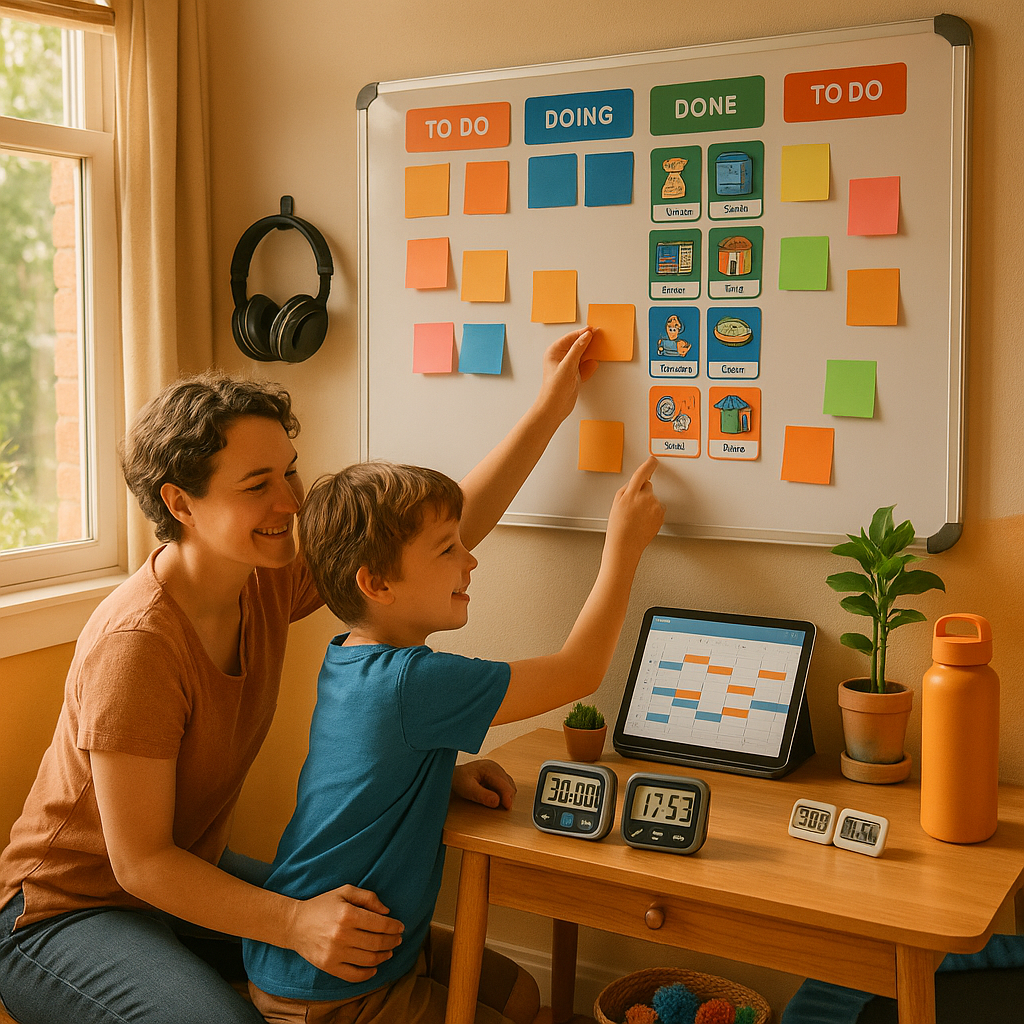
Visual Anchors: Utilize visual aids to track routines and keep everyone on the same page. Options include:
- Laminated checklists with moveable icons for younger children
- Digital dashboards or shared calendars for older kids and adults
- Color-coded timers outlining time blocks for morning or evening transitions
Routine Sandwiches: Bookend challenging parts of your day with predictable rituals. For example, establish the same calming activity at the start and end of bedtime, while allowing flexibility in the middle steps (like the order of getting pajamas on or brushing teeth).
Transition Buffers: Plan for ADHD’s unpredictability by adding buffer time between activities. This extra space (five to ten minutes between tasks) provides grace for inevitable slowdowns, preventing stress when things take longer than planned.
Integrating ADHD-Friendly Energy and Interests
Leverage natural ADHD tendencies to keep routines engaging and sustainable.
Movement Breaks: Regularly incorporate physical movement. This can take the form of:
- Family dance sessions before homework or chores
- Short bursts of physical activity, such as stair climbs or jumping jacks, between tasks
- Walk-and-talks for important discussions or winding down in the evening
Novelty Infusions: Refresh routines to prevent boredom while maintaining essential structure.
- Introduce “Wild Card Wednesdays” where an aspect of the routine is switched up
- Rotate responsibilities among family members each week
- Allow children to choose the order of certain tasks within the structure (for example, letting them decide whether to do homework before or after a snack)
Energy Matching: Sync demanding tasks with natural energy peaks.
- Schedule important assignments or chores during times when focus is naturally higher (often after medication kicks in or during the “evening burst” some people experience)
- Reserve creative or less structured activities for when the family’s energy dips
Bouncing Back When Routines Falter
Even the best systems will be tested, especially with ADHD in the mix. Plan for recovery, not perfection.
Reset Protocol: Give your family a designated way to start fresh. This might mean pausing for deep breaths or simply announcing a “do-over” moment.
Minimum Viable Day: On tough mornings or overwhelming afternoons, fall back on a simplified version of your regular routine. Identify the three essential tasks that must happen to get out the door or end the day well, and focus only on those.
Normalize Forgiveness: Make it a habit to reassure yourself and your child that hitting bumps in routines is not a failure. Acknowledge setbacks and remind everyone, “We get to try again tomorrow.”
A parent who implemented these techniques shares, “Our ‘bare-minimum morning’ has taken the pressure off. When we’re running late or things unravel, we switch to this plan and our mornings are calmer and much less stressful.”
Creating flexible routines grounded in empathy and adaptability builds a foundation for ongoing success. The next critical step is learning to prioritize your own well-being as a parent, so you can keep showing up as your best self.
Prioritizing Parent Self-Care: It’s Not Selfish, It’s Essential
As an ADHD parent, caring for yourself is essential to your ability to care for your child. Neglecting your own needs leads directly to burnout, heightened symptoms, and reduced capacity for patience and creative problem-solving. Yet, feelings of guilt or cluelessness about what self-care actually looks like for ADHD adults often get in the way.
The Oxygen Mask Principle and Why It Matters
Just as you’re instructed to secure your own oxygen mask in a flight emergency, ADHD parents must put their own wellness first. Research proves that parents practicing regular self-care:
- Regulate their emotions more effectively, especially in high-stress situations
- Maintain consistency in their parenting style, even when faced with setbacks
- Experience more patience and less conflict during their child’s intense symptom cycles
- Are less prone to parental fatigue and mental health challenges
As one ADHD parent said, “Taking time for myself isn’t just self-preservation. It’s a necessary investment in my family’s daily stability.”
ADHD-Specific Self-Care Strategies
Generic self-care advice (spa days, lengthy alone time) can feel out of reach or ineffective for ADHD adults. Here are ways to tailor restoration to your unique brain:
Micro-Moments of Recharge: Instead of relying on rare stretches of free time, weave restorative practices into the day in three-to-five minute segments.
- Practice deep breathing or grounding exercises between tasks
- Step outside and notice your surroundings during a child’s TV show or lunch break
- Sing, dance, or listen to your favorite song while driving or prepping dinner
Balancing Stimulation and Regulation: ADHD brains crave both excitement and calm. Meet both needs by:
- Seeking engaging challenges or puzzles for stimulation, especially during energy slumps
- Using weighted blankets, calming music, or mindful showers for regulation when feeling overwhelmed
Medication and Follow-Up Consistency: Stable routines hinge on your own health.
- Set alarms or use pill organizers to ensure you take your medications consistently
- Schedule and keep regular appointments with mental health professionals and your primary care provider
- Track symptoms or energy patterns to spot when you need extra support
Investing in your own well-being is not selfish; it is a powerful act of responsibility for everyone in your household. Self-care doesn’t just recharge you. It equips you to be the steady presence your family needs.
Broader Applications: Building on Shared Neurodivergence Across Life Sectors
While these strategies are framed around family life, the principles of shared understanding, flexible systems, and community support extend to many fields.
- In the workplace: ADHD-friendly routines, regular movement, and open communication foster creativity and prevent burnout for neurodivergent professionals and teams.
- In education: Co-creating flexible systems with neurodivergent students enables better classroom engagement and learning outcomes.
- In healthcare: Patient-centered care with collaborative systems improves adherence and well-being for both neurodivergent adults and children.
- In legal, marketing, and consumer-facing settings: Emphasizing authentic communication and creative workflows benefits both service providers and neurodivergent clients, driving inclusive practices and innovative solutions across industries.
Understanding and leveraging neurodiversity is not just a family issue. It is a catalyst for resilience and adaptability in every sphere of modern life.
Conclusion
When both parent and child have ADHD, the journey shifts from managing deficits to celebrating difference. Your family dynamic becomes an environment where authentic empathy, real-world creative problem-solving, and flexible self-care elevate daily life. The systems, conversations, and attitudes you cultivate today lay the groundwork for a legacy of resilience and connection that will benefit future generations.
Looking forward, families that embrace their distinctly brilliant “operating system” will not only thrive at home but adapt with agility to broader life challenges. By choosing compassion over criticism, structure over rigidity, and community over isolation, you equip your family with skills that transcend ADHD. The future belongs to those who see neurodivergence not as a limitation, but as the spark that drives innovation, empathy, and authentic growth.
The question is not whether you’ll face challenges. It’s how creatively and courageously you’ll use them to build a thriving, connected life.




Leave a Reply