

Key Takeaways
- Tame chaos with a repeatable packing checklist. Using a saved digital or physical checklist keeps essentials at the forefront, reduces overwhelm, and minimizes last-minute panics or forgotten items.
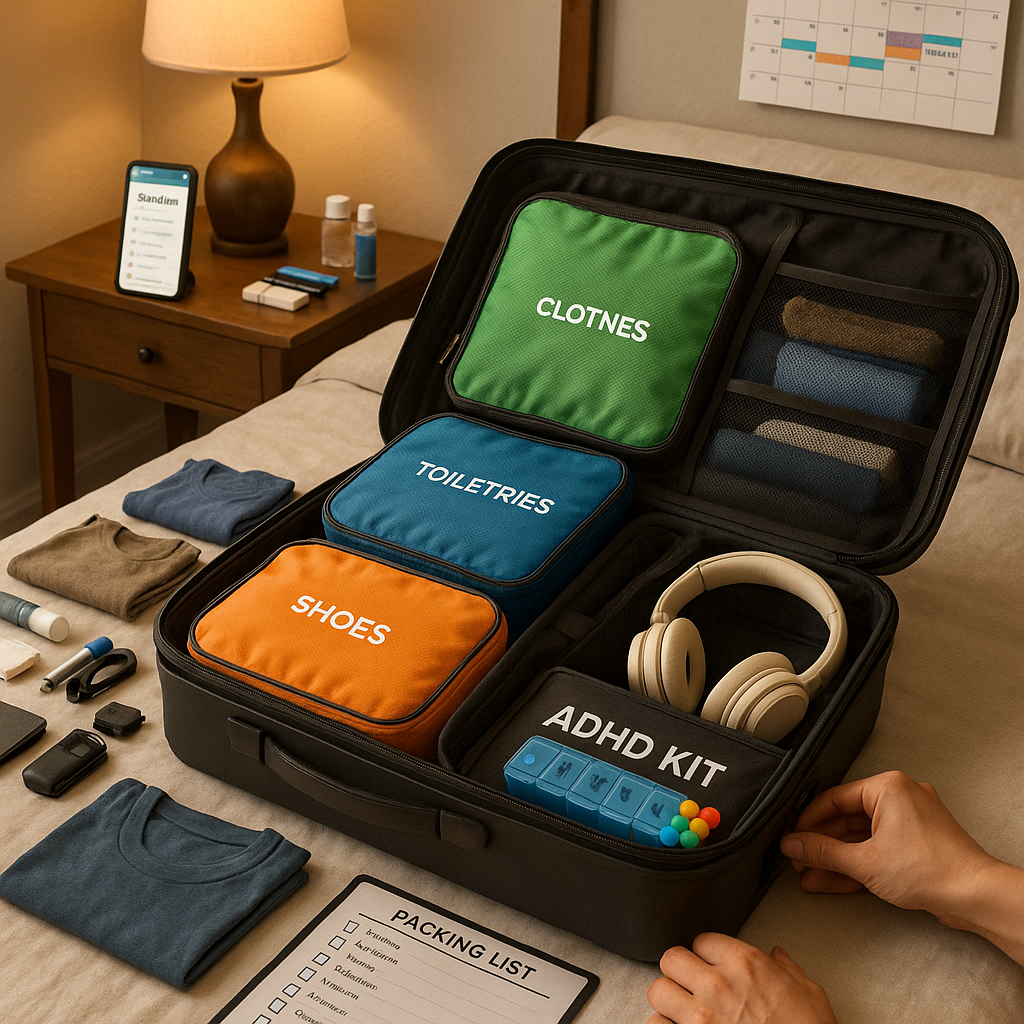
- Pre-pack your “ADHD kit” to counter travel curveballs. Keep a ready-to-go pouch containing medication, fidgets, chargers, snacks, and comfort items; this ensures you have tools to support focus and self-regulation wherever your travels take you.
- Break packing into micro-tasks to prevent overwhelm. Divide packing into manageable 10-minute segments (clothes, toiletries, tech, etc.), and check off items as you go. This creates momentum, turning dread into tangible progress.
- Designate “home bases” in your bags to maintain order. Assign specific pockets for passports, headphones, and other key items. Returning items to their “homes” reduces frantic searches and wasted time.
- Automate reminders to catch memory leaks. Set digital alerts for must-have essentials (such as medication, chargers, or your wallet) before leaving or changing locations. Technology becomes your external working memory and safety net.
- Anchor routines for brain and body stability while on the road. Keep one familiar ritual (morning coffee, journaling, a favorite playlist) to help regulate energy and provide comfort in unfamiliar settings.
- Build in decompression time for travel transitions. Schedule gentle buffer zones before and after travel to counter sensory overload and allow yourself time to reset and recharge.
- Embrace sensory-friendly gear for on-the-go comfort. Items like noise-canceling headphones, eye masks, and weighted accessories can create calm and boost focus in unpredictable travel environments.
- Celebrate wins (even the small ones) to fuel motivation. Give yourself credit for each micro-victory, whether it’s packing on time, getting through security, or remembering a key item. Recognizing your progress builds confidence and motivation for future travel.
These strategies don’t just tame travel chaos. They transform trips into opportunities for self-mastery and empowerment. In the following sections, we’ll break down each tip with relatable stories and actionable tools, helping you travel smarter, not harder.
Introduction
Airport security lines can feel endless while your mind races with a packing list that seems to disappear as soon as you think of it. That nagging fear of forgetting something builds before you even close your suitcase. For ADHD travelers, every trip is a blend of adventure and potential chaos: routines disrupted, essentials misplaced, and travel anxiety lurking in the background.
Yet managing ADHD during travel does not mean giving up the thrill of exploring new places or surrendering to stress. With the right packing tips and reliable routines, your next business trip or vacation can become not just manageable, but genuinely empowering. Together, let’s unpack practical, sanity-saving strategies so your next journey feels more like freedom and less like damage control.
The ADHD Traveler’s Challenges and Mindset Shifts
Travel offers excitement and opportunity, but for those with ADHD, it can unleash a whirlwind of executive function challenges. The collision of disrupted routines, unfamiliar environments, and the responsibility of remembering countless details often ushers in overwhelm. Many ADHD travelers find themselves scrambling at the eleventh hour, forgetting essentials, or battling anxiety before and throughout their trip.
What makes travel especially difficult for the ADHD brain? Some common executive function hurdles include:
- Task initiation: The mental block to start packing usually lifts only as deadline pressure mounts.
- Working memory: Keeping track of everything to bring and each crucial preparation step.
- Time management: Accurately judging how long packing and other preparations will require.
- Organization: Developing reliable systems for belongings in novel environments.
Despite these challenges, the ADHD brain can shine in new places. There’s the adaptability, creative problem-solving, and that talent for deep immersion in experiences. The powerful shift comes when you stop fighting against your wiring and instead design supports that play to your strengths.
Adopt this fresh perspective: your neurodivergent brain does not make you an unreliable traveler. It just needs travel systems built differently. By implementing adaptive structures, you can transform travel from a source of stress into a springboard for adventure and growth. Success is not about sticking perfectly to a plan, but rather establishing flexible frameworks that support your ADHD brain wherever you go.
Remember, no one is a perfect traveler. Even neurotypical people forget items or feel stressed. The goal is not flawlessness, but discoverability. When you make travel more enjoyable and manageable through approaches tailored to your needs, you’re already winning. The following strategies are designed to do just that.
Strategy 1: The Master Packing Template
For those with ADHD, packing from scratch each trip feels like constructing a house without a blueprint. That’s where a personalized packing template steps in, serving as your travel foundation and eliminating the need to start over every time.
Creating Your Evergreen Packing List
A master packing template goes far beyond a basic checklist. It becomes an adaptable system that covers a range of trips, durations, and situations:
- Identify your core essentials for every trip (medications, toiletries, phone charger, and must-have items).
- Organize by brain-friendly categories (Morning Routine Items, Tech, Clothing Layers, Comfort Gear).
- Create sub-sections for specific trip types:
- Beach getaways
- Business travel
- Outdoor adventures and camping
- Urban explorations
- Family or group visits
By storing this template digitally (in your favorite app or notes platform), you can quickly update and re-use it for any destination or occasion.
Template Implementation Tips
Digital tools such as Notion, Trello, and specialized packing apps like PackPoint make checklists interactive and reusable. Organize your template using these guidelines:
- Use toggles or collapsible sections for clarity, showing only what you need.
- Specify quantities (such as “Socks: 1 per day + 2 extra”).
- Include special reminders for frequently forgotten items.
- Leave blank lines for trip-specific needs.
If you prefer paper-based systems, laminate your checklist and store it in your suitcase, or keep a packing journal divided by trip types for quick access.
Customizing for Your ADHD
Your packing template should address your individual ADHD patterns:
- Add a section for sensory comfort gear if you’re sensitive to certain environments.
- Include packing time estimates if time blindness is a problem.
- Mark absolutely-essential items with bold highlights so nothing gets left behind.
The main benefit of a master template is that it shifts packing from an open-ended creative task (which can trap you in perfection paralysis) to a straightforward implementation task. This helps reduce decision fatigue, making it easier for your brain to take action.
This foundational tool becomes even more powerful when complemented by visual systems, the next strategy on our list.
Strategy 2: Visual Packing Systems
ADHD brains naturally gravitate toward visual processing, making traditional text lists feel dry and abstract. Visual packing systems work with your strengths by turning preparation into an engaging, hands-on process.
The Staging Area Method
Make packing a visible and ongoing process rather than a last-minute scramble.
- Set up a designated physical space (bed, table, or floor area) as your “packing headquarters” two to three days before your trip.
- Use this area to sort belongings by your packing categories.
- As you think of items or find essentials, place them directly in the corresponding “zone.”
- Periodically glance at your staging area. This gives your brain multiple chances to remember missing items and reduces the need to rely on memory alone.
This method works especially well for people who remember things at random times. It allows for immediate action and fewer forgotten essentials.
Color-Coding and Organizational Cues
Color is a powerful tool for translating organization into brain-friendly visuals:
- Assign different colored packing cubes or bags to categories (green for clothing, orange for tech, etc.).
- Use colored tags or stickers to flag “do not forget” essentials.
- Create a color-coded grid or checklist for quick visual reference.
If you travel with others, give each person a signature color to avoid mix-ups and streamline unpacking.
Photo Documentation for Replicating Systems
The return journey often feels messier and more hectic. Reduce anxiety by documenting your system visually.
- Before you leave, take photos of your bag when fully organized.
- Snap pictures of drawers or bathroom counters when you arrive at your accommodation.
- Refer back to these photos when packing up to ensure you’re not leaving anything behind.
These visual prompts make uncertain memories tangible, offering your brain a reliable anchor for peace of mind.
Visual packing systems, combined with your master template, reshape trip preparation into a concrete, tactile, and less overwhelming process. As you master these, it’s equally important to give yourself the gift of realistic timelines with built-in buffers.
Strategy 3: Time Blocking and Buffer Planning
Time blindness, that difficulty gauging how long things take, is a major ADHD challenge. It can turn travel prep into an exhausting marathon. Employing intentional time blocks and generous buffers helps create a sustainable schedule that honors your unique brain.
The 3x Rule for Realistic Prep Times
First, try making your own time estimates more realistic:
- Estimate the time you think packing and prep will require.
- Multiply that number by three.
- Begin preparations according to this new schedule.
For example, if you think you need one hour to pack, block off three hours in your calendar. This accommodates distractions, unexpected needs, and ADHD’s inevitable spontaneity.
Progressive and Layered Packing
Tackle packing in phases, spreading tasks across days:
- Three days out: Prepare infrequently used, bulky, or seasonal items.
- Two days out: Pack the majority of clothing and secondary essentials.
- The day before: Add everyday toiletries, devices, and last-minute items.
- Travel day: Use extra time for final checks and overlooked items.
This layered approach respects the ADHD need for manageable, bite-sized tasks instead of overwhelming sprints.
Building Gentle Transition Buffers
Navigating transitions is particularly tough for ADHD brains, especially during travel. Schedule buffer time:
- At home before departure (unstructured decompression, 30–60 minutes).
- Upon arrival at your destination (60 minutes before jumping into planned activities).
- Between daily travel events (15–30 minutes for resetting).
Transition buffers reduce stress from rushing and provide space for emotional or sensory recalibration.
Tools for Timed Accountability
Digital calendars can help back up your intentions:
- Create color-coded blocks for each travel prep stage.
- Set reminders with built-in buffer time.
- Specify action steps in each calendar event.
If pen and paper works better, draw a visual timeline and use sticky notes to represent each task and transition.
Time blocking and buffering are not just organizational hacks; they are conscious strategies that align the realities of ADHD time perception with real-world demands. Next up, discover how technology can act as your cognitive safety net.
Strategy 4: Leveraging Technology for ADHD-Friendly Travel
Harnessing technology transforms your routine from forgetful to foolproof by acting as an extension of your working memory and executive function. Effective digital solutions relieve your cognitive load, making travel less stressful.
Setting Automated Reminders and Alerts
Smartphones and wearable devices can provide external reminders, making it easier to remember essentials for every leg of your journey. Consider the following:
- Set recurring reminders for medication, chargers, passport, wallet, or boarding passes.
- Use checklist apps with scheduled push notifications leading up to departure.
- Automate location-based reminders that ping you when leaving home, hotel, or the airport.
These digital prompts act as compassionate nudges, allowing you to focus on the adventure instead of constant self-monitoring.
Smart Packing and Planning Apps
Apps like PackPoint, Notion, or Google Keep can help you manage multi-step travel tasks, track what’s packed, and flag missing items. Some tools let you share lists with travel companions for added accountability.
- Choose apps that allow customization by trip type or include templates tailored to your needs.
- Use voice notes or photo uploads to make reminders more accessible and ADHD-friendly.
- Sync lists across multiple devices so updates are available wherever you are.
Digital Organization in Transit
Stay organized on the go by leveraging device tools:
- Scan travel documents and store them in a cloud folder for easy access.
- Use calendar apps to map out your travel itinerary, including buffer periods and downtime.
- Set up quick-access notes for hotel addresses, confirmation numbers, or emergency contacts.
By letting technology do some of the heavy lifting, you create breathing room for creativity, connection, and presence throughout your journey.
Technology is only one part of a holistic strategy. Remember to balance digital solutions with sensory-friendly choices, ritual anchoring, and self-compassionate routines for complete support.
Conclusion
Traveling with ADHD is not about chasing perfection. It’s about crafting systems, supports, and rituals that respect both your challenges and your creative strengths. By integrating master templates, visual and color-coded systems, strategic time buffers, and technology-powered reminders, you can transform travel from an exercise in damage control into an energizing expression of self-mastery.
The power of ADHD-friendly travel does not lie in rigid routines, but in designing adaptable frameworks that move with you. The real adventure isn’t in flawless execution, but in learning how your brain thrives in new environments. With the right systems, every trip becomes a stage for growth, curiosity, and proof that being “not broken” means being brilliantly equipped for whatever comes next. As you plan your next journey, remember: freedom is found not in fighting your wiring, but in using it as your advantage. Travel on your terms, celebrate each step forward, and let every trip remind you that your unique mind is built for both discovery and resilience.




Leave a Reply