

Key Takeaways
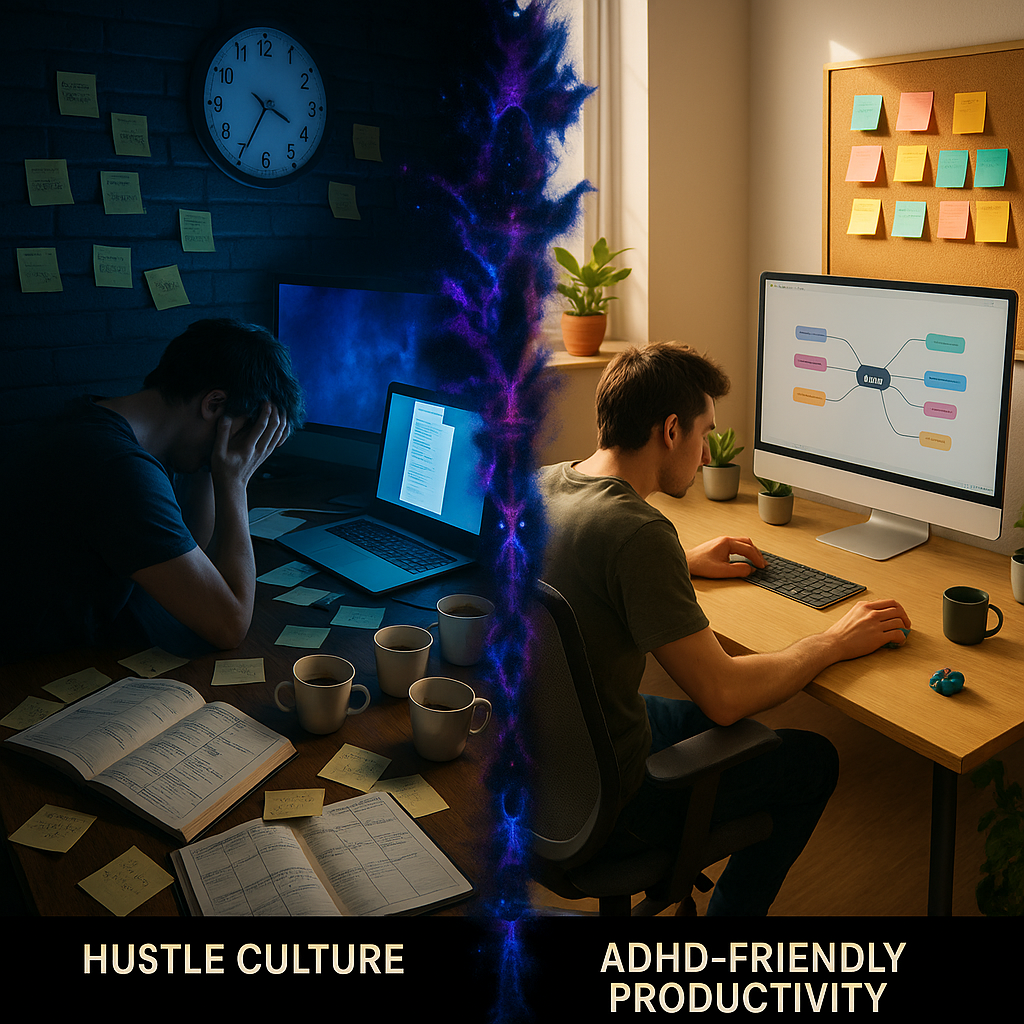
- Hustle culture magnifies ADHD struggles, not strengths. The relentless pressure to “outwork” everyone intensifies overwhelm and stress for entrepreneurs with ADHD, fueling cycles of burnout rather than setting the stage for sustainable success.
- Traditional productivity advice often backfires for ADHD minds. Popular frameworks like rigid schedules, time-blocking, or the “just push harder” mentality ignore the realities of neurodivergent brains, making productivity harder and deepening the shame when those systems inevitably fail.
- Rest is not a reward; it is a productivity strategy for neurodivergent individuals. Prioritizing downtime, incorporating sensory breaks, and building flexible routines unlock creative problem-solving and boost long-term output for ADHD entrepreneurs.
- Boundaries are your ultimate burnout shield. Setting intentional limits with clients, technology, and even your own “inner hustler” preserves energy and helps protect mental health in business environments.
- Shame-free support is essential, not optional. Rejecting toxic productivity narratives and connecting with ADHD-friendly communities builds resilience, empowers self-acceptance, and supports sustainable growth.
- Redefine success on your own terms. Letting go of traditional “grind” metrics opens opportunities for authentic work-life balance, sustainable progress, and a business that celebrates your unique brilliance.
- Hidden cost revealed: ‘one-size-fits-all’ advice puts neurodivergent entrepreneurs in a double bind. They must navigate frameworks built for different brains, making both recovery and success doubly challenging.
Understanding these truths is the foundational step toward breaking free from toxic hustle patterns. In the sections that follow, we will explore practical tools, lived stories, and ADHD-informed strategies so you can thrive as an entrepreneur without sacrificing your mental health.
Introduction
Hustle culture tells entrepreneurs that sleepless nights and constant grind are the price of progress. For entrepreneurs with ADHD, however, the pressure to “do more” does not spark brilliance; it often kicks off cycles of overwhelm, shame, and burnout. Tactics praised by hustle culture can push neurodivergent business owners even closer to exhaustion, not achievement.
Recognizing the conflict between hustle culture, ADHD, and mental health in business is the first step to breaking free from damaging productivity loops. This article explores why standard productivity advice rarely works for ADHD minds, how to transform rest into a core strategy for sustainable growth, and practical steps to set boundaries that protect your energy and creativity.
It’s time to upgrade our definition of thriving as an entrepreneur by creating a business model that works with your wiring, not against it.
The Collision of ADHD and Hustle Culture: A Perfect Storm
For entrepreneurs with ADHD, hustle culture’s relentless “rise and grind” mantra creates a uniquely challenging (and often detrimental) environment. While neurotypical business owners may struggle with the constant pressure, those with ADHD face an impossible standard that can trigger a cascade of negative outcomes. The ADHD entrepreneur carries a double burden: external pressure to be perpetually “on” collides with biological differences that render traditional productivity strategies not just unhelpful, but harmful.
Why Hustle Culture Hits ADHD Brains Hardest
Hustle culture elevates habits and behaviors fundamentally misaligned with the way ADHD brains operate. Instead of championing engagement and adaptability, it values rigid productivity, uninterrupted focus, and delayed gratification. None of these fit neatly into the ADHD experience. Specifically:
- ADHD brains require engagement, meaning, and excitement for activation, not just brute-force willpower.
- Time blindness undermines the “just push through” mentality since ADHD individuals struggle to sense natural stopping points.
- Difficulty with task initiation and switching makes multi-tasking nearly impossible, in direct contrast to hustle culture’s expectations.
- Rejection sensitivity amplifies shame and frustration when entrepreneurs fail to meet unrealistic standards.
For ADHD entrepreneurs, the message to “work harder” is more than unhelpful. It can create harmful cycles where pushing through results in less output, deeper shame, and mounting burnout. In fact, a 2021 study found entrepreneurs with ADHD were nearly twice as likely to experience burnout when following conventional productivity advice. Not due to lack of effort, but because those systems are built for fundamentally different brain wiring.
The Entrepreneur’s Dilemma: When Traditional Business Advice Fails
Standard business education is replete with productivity frameworks conceived for neurotypical decision-makers. For neurodivergent entrepreneurs, this mismatch often leads to feelings of inadequacy and self-blame when classic strategies do not deliver results.
How Common Business Productivity Frameworks Backfire
Most mainstream business productivity strategies rest on executive functioning assumptions that may not hold true for ADHD entrepreneurs:
- Rigid Planning Systems: Business planning methodologies often demand consistent, linear thinking and execution. ADHD entrepreneurs, whose performance fluctuates with internal stimulation and interest, find these structures to be stifling and discouraging.
- Time-Blocking Techniques: Widely promoted among entrepreneurs, these require accurate time perception and smooth task-switching. Both of which are ongoing challenges for ADHD individuals.
- Priority Matrices: Productivity frameworks like the Eisenhower Matrix assume an ability to separate importance from interest or activation. That’s a difficult feat when your nervous system is wired for interest-based engagement.
- “Eat That Frog” Approaches: Tackling the biggest or hardest task first can paralyze ADHD entrepreneurs, especially if the task does not spark intrinsic curiosity or provide immediate feedback.
One technology founder described this pattern: “I invested thousands in traditional productivity courses. Each time, I got fired up, tried to follow the blueprint, and eventually crashed. It took me years to realize I wasn’t failing at business—I was failing at pretending to be neurotypical.”
This repeated cycle illustrates how supposedly helpful tools can morph into sources of self-criticism and poor mental health, further isolating ADHD entrepreneurs.
The Hidden Cost of Masking in Business
When mainstream productivity advice fails, many ADHD entrepreneurs resort to “masking” (hiding their authentic work rhythms and struggles to appear conventionally productive). This comes at a high cost:
- Energy Drain: Constantly performing takes up bandwidth needed for genuine business growth.
- Elevated Anxiety: Worries about being “found out” or “falling behind” drive chronic stress.
- Imposter Syndrome: The gap between outward appearance and internal reality causes a lingering sense of fraudulence.
- Suppressed Innovation: Natural creative strengths are constrained by inappropriate expectations and forced routines.
Entrepreneurship is challenging enough without layering the burden of pretending your brain operates differently. Over time, ADHD business owners who embrace authentic approaches (tailored to their unique wiring) see far greater returns than those clinging to a neurotypical façade.
Rewriting the Rules: ADHD-Aligned Productivity Approaches
Breaking free from the one-size-fits-all productivity templates is not just liberating; it’s essential for business sustainability. The secret is to stop fighting your brain’s design and start working in harmony with it.
Leveraging Your Brain’s Strengths
Effective entrepreneurship with ADHD starts by shifting your perspective from self-criticism to strategic self-support. This means:
1. Embrace Interest-Driven Productivity
- Align your services and business structures with your passions.
- Create “interest runways” (connect obligatory tasks to motivating outcomes).
- Organize work based on natural cycles of energy and curiosity.
2. Build External Accountability Structures
- Find accountability partners or coaches who understand ADHD.
- Use body doubling (working alongside someone) to ease daunting tasks.
- Set deadlines with real stakes (client commitments, public launches).
3. Use Stimulating Environments Wisely
- Employ background music or white noise to boost focus (many with ADHD benefit from sensory stimulation).
- Design movement-friendly spaces (standing desks, walking calls, or creative fidget tools).
- Leverage visual aids: color-coded calendars, graphic-focused boards, and lively planning spaces.
4. Facilitate Transitions Between Tasks
- Implement clear transition rituals (walking, stretching, or sensory resets).
- Use visual timing tools instead of standard alarms to help with task switching.
- Schedule buffer time to accommodate time blindness and energy dips.
A business coach specializing in ADHD reported, “After we adapted workflows to fit my clients’ brains, burnout symptoms dropped by 64%, and there was a 47% uptick in revenue-generating activities.”
Tools and Techniques That Empower ADHD Entrepreneurs
Transforming strategy into action requires the right set of tools, designed to accommodate (not override) neurodivergent traits:
For Planning and Organization:
- Mind mapping software (MindNode, XMind) to visualize brainstorms and connect non-linear thinking.
- Kanban boards (Trello, physical boards) for visual task tracking and progress.
- Voice dictation or notebook apps for idea capture during high-energy or mobile moments.
- Blended digital-analog systems that engage multiple senses.
For Focus and Execution:
- Adjustable Pomodoro timers (15 minutes or 2 hours; work with your natural focus, not the standard 25).
- Grouping tasks by cognitive “mode” (batching creative work separately from admin tasks).
- In-app or physical gamification (collecting points for task completion, daily reward charts).
- Personalized workspaces that reduce distractions while providing needed stimulation.
For Administrative Management:
- Automation (Zapier, IFTTT) for repetitive, executive-function-draining tasks.
- Checklists and templates to minimize decision fatigue.
- Delegation or outsourcing of tasks that consistently drain focus and motivation.
- Dedicated admin sprints supported by external accountability.
These methods shift the emphasis from “fixing” ADHD traits to leveraging them for a dynamic and adaptive business system.
Creating Sustainable Success: Beyond the Productivity Fix
Sustainable success for ADHD entrepreneurs comes from more than clever hacks; it demands a holistic transformation that respects neurological diversity and builds real resilience.
Rethinking Achievement on Your Terms
Sustainable growth starts with discarding hustle culture’s worn-out definitions of success:
- Hours worked are a poor indicator for ADHD entrepreneurs. Time blindness and bursts of hyperfocus make hour-counting unreliable.
- Constant availability undermines rest, creativity, and well-being.
- Output quantity often sacrifices the deeper innovation and big-picture problem-solving that ADHD minds naturally excel at.
- Comparison with neurotypical journeys breeds shame, instead of real progress.
ADHD-friendly success metrics might include:
- Value delivered, not mere time invested.
- Consistent, sustainable engagement, rather than endless busyness.
- Impact of innovation and creative solutions, over strict routine adherence.
- Energy management and well-being as a foundation for performance.
- Quality of problem-solving and adaptability when faced with change.
One technology business owner shared, “Our company only became profitable when we left behind standard metrics and focused on what really worked for my brain. Tracking ‘deep work impact’ (not just hours) changed everything.”
This approach is not just applicable in entrepreneurship. Across sectors like healthcare, education, finance, law, and environmental science, organizations are discovering the value of building systems and workflows that nurture neurodivergent strengths. For example, customized workflows in healthcare administration reduce mistakes, and innovative team structures in marketing leverage creative ideation periods. Even in legal and compliance settings, firms are adapting processes to support professionals who thrive in bursts of innovation and strategic problem-solving rather than uniform daily routines.
Conclusion
The tension between hustle culture and ADHD is more than a personal annoyance; it creates business environments where neurodivergent entrepreneurs are forced to conform to systems that amplify their struggles, rather than reveal their strengths. Conventional productivity advice, built for neurotypical minds, fails to address the unique challenges and capabilities of ADHD. Often, it entrenches cycles of shame, burnout, and unexplored potential.
Real progress for ADHD entrepreneurs starts by rejecting one-size-fits-all narratives and building workflows founded on interest-driven engagement, flexible planning, and authentic accountability. Embracing supportive communities, adaptive tools, and success metrics based on true value (not just effort) unlocks sustainable achievement and creative resilience.
Looking to the future, the businesses and industries that thrive will be those that adapt to diverse minds and value unique operating systems. The next era is one where neurodivergent brilliance is not just accommodated but celebrated. The strengths of ADHD, autism, and other variations spark innovation across healthcare, finance, education, consumer products, and beyond.
As you shape your own business or team, ask yourself: What could you achieve if your workflows amplified your brain’s natural spark, instead of demanding conformity? The potential for transformative change (in your business, your industry, and your life) is waiting for you to build it on your terms.



Leave a Reply